The Real Cost of Managing Compliance in Spreadsheets
Spreadsheets feel free. No license fees, no implementation timeline, no vendor call to schedule. Your quality team already knows how to use them. That's exactly why so many regulated organizations still run document control, training records, and CAPA tracking through a patchwork of Excel files.
The problem is that spreadsheets were never built for compliance. They don't know what a version is. They don't know who approved what. They don't know when a training record expires or when a CAPA is overdue. Every one of those things has to live in someone's head, and that person eventually goes on vacation, changes roles, or leaves the company.
The cost of that gap doesn't show up on an invoice. It shows up in audit findings, in wasted hours, and in decisions made on outdated information. Here's where that cost actually comes from.
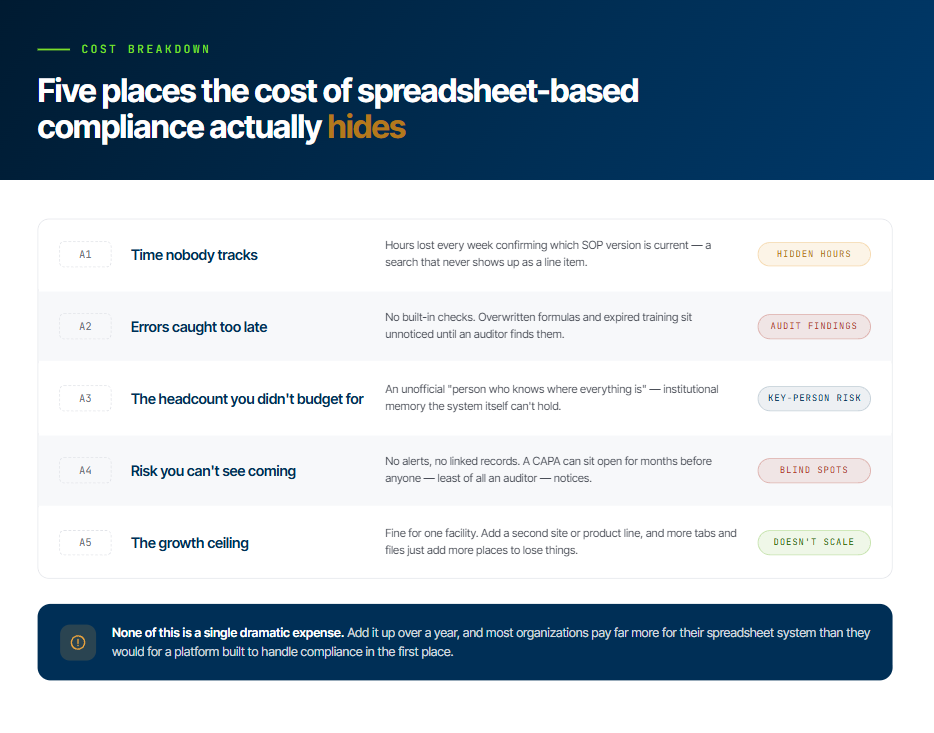
The Time Nobody Tracks
Ask your quality team how long it takes to confirm they're looking at the current version of an SOP. Most won't have a fast answer, because the honest answer involves checking a shared drive, cross referencing a change log, and maybe emailing someone to confirm.
That search happens dozens of times a week across a quality team. None of it shows up as a line item anywhere. It just quietly eats hours that should go toward closing CAPAs, reviewing risk assessments, or preparing for an audit.
A spreadsheet can hold a lot of data. It can't tell you which version is authoritative. That distinction has to be manually maintained, and manual maintenance breaks down the moment more than one person touches the file.
The Errors You Don't Catch Until an Audit Finds Them
Spreadsheets have no built in checks. Someone can overwrite a formula, sort a column out of order, or save over the wrong file, and nothing stops them. The mistake sits there until someone happens to notice, and in a lot of cases, that someone is an external auditor.
Training records are a common failure point. A spreadsheet tracking completion dates has no way to flag when a certification is about to expire or when a new hire hasn't completed required training. Someone has to remember to check. When they don't, the gap surfaces during an inspection, and now it's a finding instead of a fixed problem.
Document control carries the same risk. A spreadsheet based change log can show that a document was updated. It can't enforce that the update went through proper review and approval before the new version reached the floor. That distinction matters to every accreditation body, and it's exactly where spreadsheet based systems fall short.
The Headcount You Didn't Budget For
Every regulated organization running compliance through spreadsheets eventually creates an unofficial role, the person who knows where everything is. They know which folder has the current SOPs. They know which tab tracks open CAPAs. They know which spreadsheet the auditor will ask for first.
That knowledge lives in one person's head because the system itself can't hold it. When that person is out, progress slows. When they leave, the organization loses institutional memory that took years to build, and the next person starts over.
This is real cost, even though it never appears as a budget line. It's the time spent training a replacement. It's the risk of information gaps during the transition. It's the fact that your compliance system depends on a person instead of a process.
The Risk You Can't See Until It's Too Late
Regulated organizations live or die by their ability to catch problems early. A CAPA that sits open for six months without anyone noticing isn't a minor issue, it's a sign the system meant to catch that gap failed.
Spreadsheets don't send alerts. They don't flag overdue items unless someone builds a manual process to check them, and manual processes are the first thing to slip when the team gets busy. By the time a pattern of missed deviations or overdue CAPAs becomes visible, it's usually because an auditor found it first.
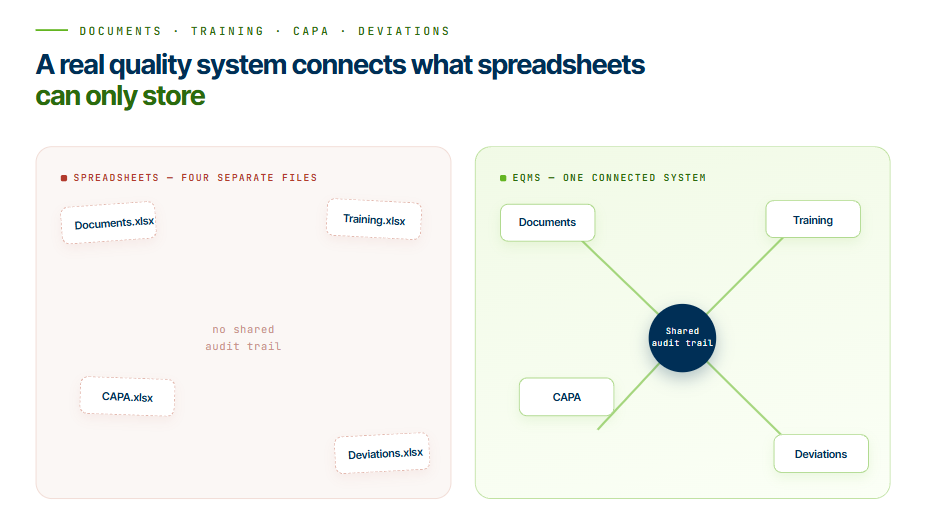
A real quality system connects these events. A deviation should be able to trigger a CAPA. A CAPA should be able to reference the document it affects. A spreadsheet can't make those connections on its own. Someone has to manually track the relationships, and manual tracking is where things get lost.
The Growth Ceiling Nobody Talks About
Spreadsheets work fine when your organization is small enough that one or two people can hold the whole system in their heads. They stop working the moment you add a second facility, a new product line, or enough headcount that no single person can track everything anymore.
At that point, the organization either invests in a real quality system or keeps adding spreadsheets, extra tabs, extra files, extra shared drives, to try to hold the weight. That second option doesn't scale. It just adds more places for information to get lost and more time spent reconciling versions that should have matched in the first place.
What This Actually Costs You
None of this shows up as a single dramatic expense. It shows up as hours spent searching instead of improving. It shows up as findings that could have been caught internally. It shows up as one overworked person carrying knowledge the whole system depends on. Add it up over a year, and most organizations are paying far more for their spreadsheet based system than they would for a platform built to handle compliance in the first place.
An eQMS solves this by connecting the pieces spreadsheets can't. Documents, training, CAPAs, and deviations live in one system with a shared audit trail, so the connections your quality system depends on happen automatically instead of living in someone's memory.
If any of this sounds familiar, it might be time to look at what a real quality management system can take off your team's plate. Talk to our team about what a move away from spreadsheets actually looks like.