
Quality management built for the multi-client complexity of contract manufacturing
A CDMO doesn't run one quality system. It runs one quality system that has to look like many — each sponsor expecting a quality manual that reflects their standards, each program running under its own deviation and change-control regime, each batch record potentially needing to satisfy two regulators simultaneously. The QMS solutions built for single-product manufacturers break at sponsor number four. Kintavo gives CDMO quality teams a single GMP-compliant platform with sponsor-isolated data, tenant-aware workflows, and cross-program metrics that stay aggregated for operations without leaking between accounts.
One platform for every quality domain a CDMO operates under.
Multi-client, multi-product quality systems for contract development & manufacturing — with sponsor-isolated data and reporting.
Document Control
Master SOPs, client-specific quality manuals, and tech-transfer packages with sponsor-isolated access.
Learn moreChange Control
Sponsor-aware change workflows with impact assessment across affected programs.
Learn moreDeviation Management
Deviation routing that respects per-sponsor SOPs and escalation paths.
Learn moreCAPA Management
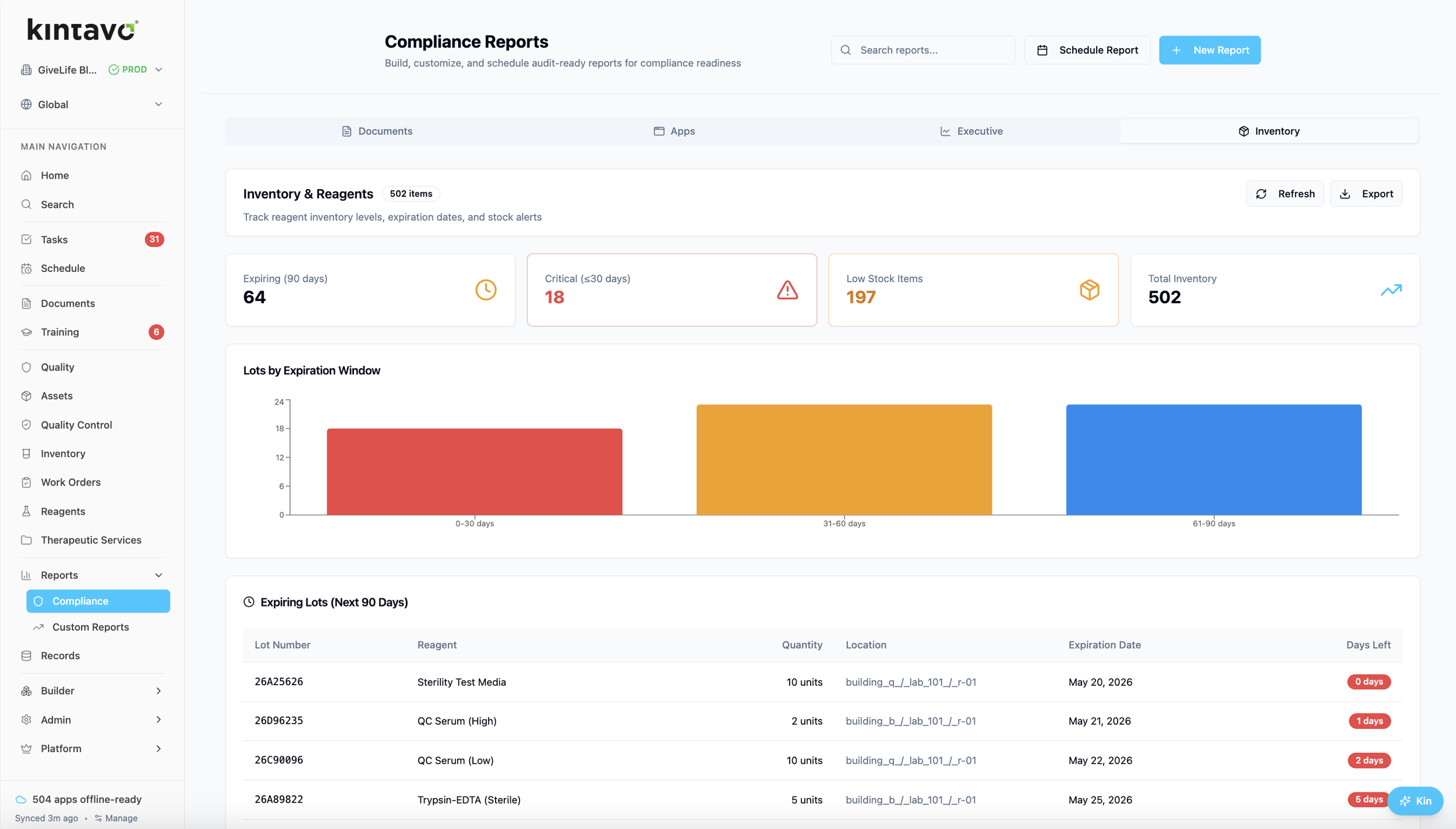
CAPA workflows scoped per program, with cross-sponsor trending visible only to operations.
Learn moreTraining Management
Role-based and client-specific training with tenant-aware competency tracking.
Learn moreSupplier Quality
API, excipient, and component supplier qualification shared across the platform — segregated where required.
Learn moreQC Analysis
OOS investigations and stability trending by client batch.
Learn moreEquipment Management
Equipment qualification, cleaning validation, and shared-asset utilization by program.
Learn more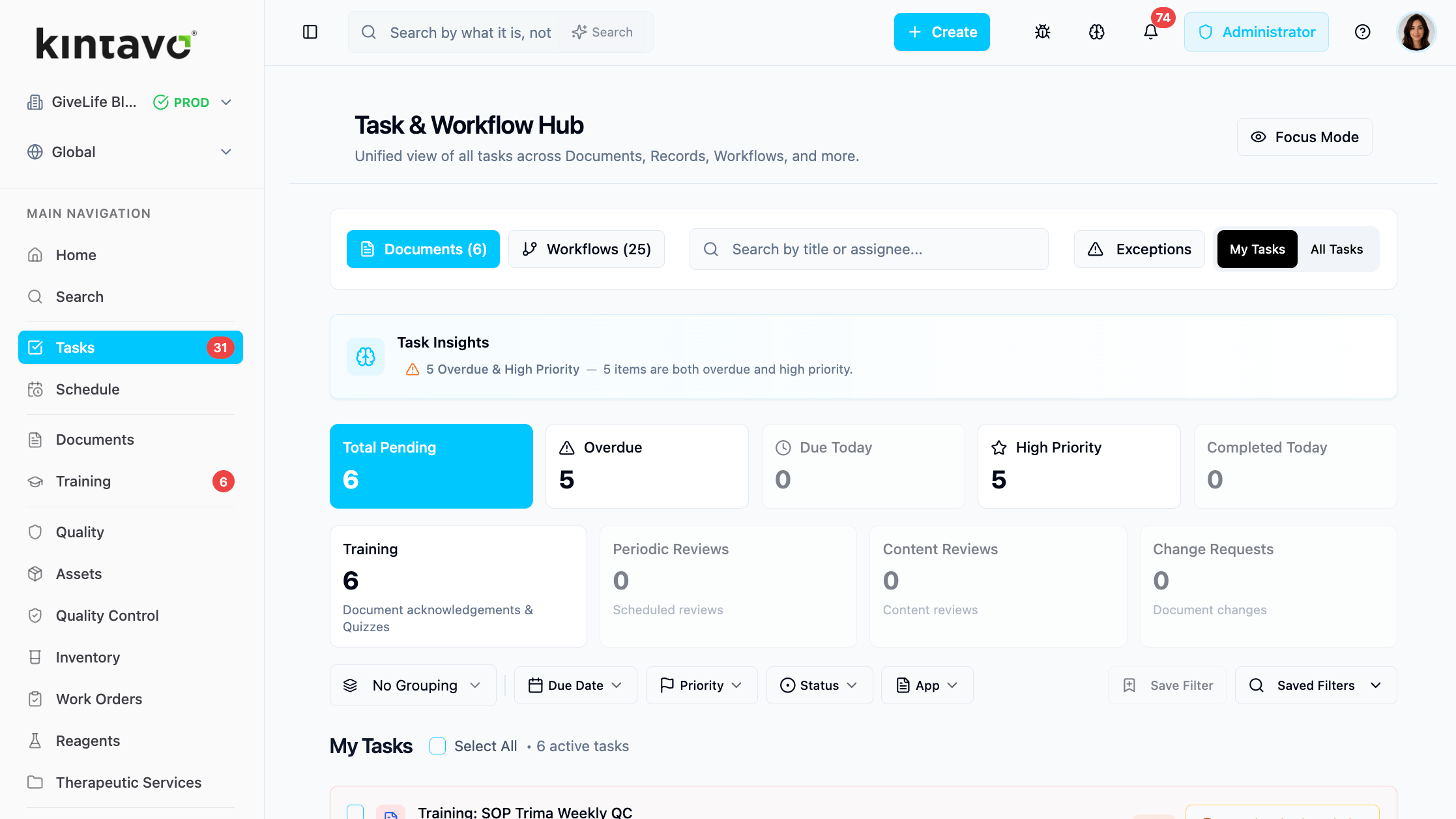
Compliance coverage for contract manufacturing.
GMP for branded, generic, biologic, and sterile manufacturing — under sponsor-specific quality agreements.
FDA cGMP for finished pharmaceuticals.
FDA electronic records and signatures for regulated functions.
EudraLex Volume 4 including Annex 1 (sterile) and Annex 15.
GMP for active pharmaceutical ingredients.
Pharmaceutical quality system across the product lifecycle.
Quality management across commercial operations.
Security and availability controls for sponsor data isolation.
One platform that looks like many.
Each sponsor sees only their data. Operations sees everything.
When your CDMO runs on Kintavo.
Sponsor data stays isolated. Operations data stays aggregated. Tech transfer stops being a project.
Every sponsor gets a tenant-isolated view of their data.
Tech-transfer packages pull from a single source of process knowledge.
Cross-sponsor metrics stay aggregated for ops without leaking between accounts.
New programs onboard in days, not quarters.
Your quality team stops maintaining N quality systems and starts maintaining one — that happens to render N different ways. New business onboards in days, not quarters.
Book your demoFAQ Questions & Answers
Q: Is Kintavo designed for CDMO quality management? Kintavo is built for the specific complexity of contract development and manufacturing organizations — multiple sponsors, multiple products, and multiple regulatory frameworks running simultaneously under one quality infrastructure. Document Control supports master SOPs alongside client-specific quality manuals and tech-transfer packages with sponsor-isolated access controls. Deviation and change-control workflows can be configured per-sponsor while sharing the same platform infrastructure. Cross-sponsor trending and operational metrics are aggregated for internal quality leadership without exposing one sponsor's data to another.
Q: How does Kintavo handle sponsor data isolation? Every sponsor program in Kintavo operates in a tenant-isolated environment — documents, deviations, CAPAs, training records, batch QC data, and change records are partitioned by program and accessible only to users with the appropriate sponsor-specific permissions. When a sponsor's quality team or auditor logs in, they see only their program's records. CDMO operations leadership can view aggregated metrics across all programs through a consolidated dashboard without any cross-sponsor data exposure. SOC 2 controls govern the security and availability of sponsor data at the platform level.
Q: How does Kintavo handle tech transfer programs? Technology transfer in Kintavo is managed as a structured document and process lifecycle rather than an ad-hoc project. The receiving site accesses the tech-transfer package — process documents, equipment qualification records, analytical method validations, and training curricula — through a controlled handoff workflow with documented review and approval at each stage. Changes during the transfer period route through formal change control with sponsor-aware impact assessment. When the transfer closes, the process knowledge lives in the same system as the ongoing GMP quality records, not in a separate folder that becomes stale the moment manufacturing begins.
Q: How does change control work across multiple sponsor programs? Kintavo's Change Control module supports sponsor-scoped change workflows — each program can have its own change categories, impact assessment templates, approval routing, and notification requirements. When a site-wide change affects multiple sponsor programs simultaneously — a shared equipment change, a raw material supplier switch, or a facility modification — the change record identifies all affected programs and routes sponsor-specific notifications and approval requests accordingly. Operations leadership can view the full cross-program impact of any site change. Each sponsor sees only the impact on their program.
Q: How does Kintavo support quality agreement management between CDMOs and sponsors? Quality agreements between the CDMO and each sponsor define the division of GMP responsibilities, escalation paths, deviation notification timelines, and change approval requirements. In Kintavo, those quality agreement obligations are operationalized as workflow configurations — the system enforces the notification timelines, routes escalations to the agreed contacts, and applies the sponsor-specific deviation categories and change classification criteria that the quality agreement specifies. When a sponsor auditor reviews your quality system, the workflows they see reflect the quality agreement they signed.
Q: How does Kintavo support sponsor audits at CDMO facilities? When a sponsor's quality team schedules an audit, Kintavo's Audit Management module organizes the audit scope, checklist, observation capture, and CAPA integration — scoped to that sponsor's program data. The pre-audit report pulls current evidence from the sponsor's isolated records: SOP currency, training completion rates, open deviations and CAPAs, change control backlog, equipment qualification status, and supplier qualification records relevant to the sponsor's materials. The sponsor's auditor sees a quality system that reflects their program, not a generic view of the CDMO's entire quality record.
Q: How does Kintavo handle shared equipment used across multiple sponsor programs? Shared manufacturing equipment in Kintavo has a single asset record — qualification history, calibration schedule, preventive maintenance log, cleaning validation — that serves all programs using it. When a deviation or equipment failure occurs, the impact assessment identifies every active sponsor program that uses the affected asset and routes program-specific notifications per each sponsor's quality agreement requirements. Cleaning validation records and campaign change notifications stay organized by program while sharing the underlying equipment history. Operations sees the full asset utilization picture; each sponsor sees only what's relevant to their program.
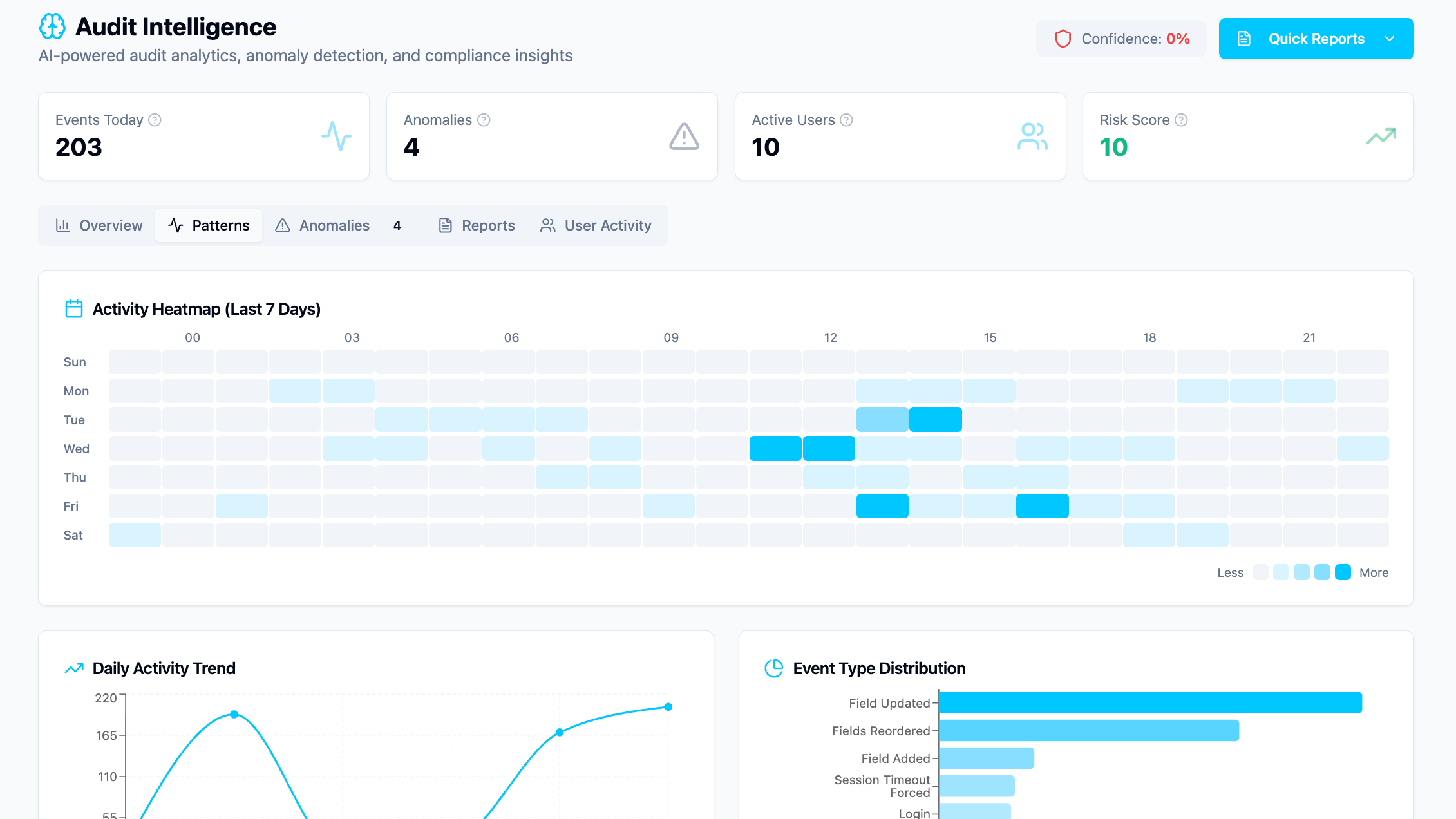
Q: How does Kintavo support regulatory inspections at CDMO facilities? FDA, EMA, PMDA, and other regulatory inspections at CDMO facilities review the site's GMP compliance as it applies to all licensed operations. Kintavo's Audit Intelligence™ monitors the site's quality posture across all programs simultaneously — surfacing overdue items, training gaps, open deviations, and calibration lapses that an inspector would find regardless of which sponsor's product is under review. Pre-inspection reports pull current site-wide evidence. During an inspection, any record for any program is retrievable in seconds. If the inspector focuses on a specific sponsor's product, the program-scoped records are immediately accessible without filtering through unrelated data.
Q: How does training management work for CDMO staff working across multiple sponsor programs? Staff at CDMOs often work across multiple sponsor programs — each with its own SOPs, process-specific requirements, and training curricula. In Kintavo, training assignments are role-based and program-aware. When a technician is assigned to a new sponsor program, the relevant training curriculum assigns automatically. When a sponsor's SOP is revised, the training assignment routes only to the staff members assigned to that program. Competency records are maintained per staff member across all programs they're qualified for. When a sponsor auditor asks for training records for the technicians who ran their batches, the program-scoped training history is retrievable immediately.
Q: Can Kintavo scale as a CDMO adds new sponsor programs? Yes. Adding a new sponsor program to Kintavo is a configuration activity, not an implementation project. The new program inherits the site's master SOP library and equipment records as a starting point, with sponsor-specific customizations applied through the Workflow Builder without IT involvement. New program setup — document library, training curricula, deviation categories, change control configuration, supplier qualification requirements, and quality agreement workflow mappings — typically completes within days. Each new program added shares the same platform infrastructure, so the quality team's operational overhead grows linearly with the program portfolio rather than multiplying with each new sponsor.
Q: What does implementation look like for a CDMO? Your implementation lead works with your quality leadership to configure the site's master SOP library, shared equipment records, deviation categories, CAPA workflows, change control gating, training curricula, and regulatory framework mappings — along with the initial sponsor program configurations — typically within the first two to three weeks of onboarding. Kintavo provides IQ/OQ documentation to support GxP computerized system validation. Existing SOPs, open quality records, and equipment records can be migrated from spreadsheets or prior systems. Most CDMOs are processing live quality events in Kintavo within 30 days of kickoff.
A CDMO is a single quality system that must look like many.
Each sponsor expects a quality manual that reflects their standards. Each program runs under its own deviation and change-control regime. Each batch record may need to satisfy two regulators that disagree on a comma.
The QMS solutions that work for single-product manufacturers break at sponsor number four. Kintavo was designed for the multi-tenant reality contract manufacturing actually requires.