
Quality management built for the pace and precision of a clinical laboratory
Clinical laboratories operate under some of the most rigorous quality requirements in regulated healthcare — CLIA, CAP, ISO 15189, and state licensing simultaneously, with QC data running in real time, calibration records tied directly to result validity, and training requirements that update every time a procedure changes. Kintavo gives clinical laboratory quality teams a single platform to manage all of it — QC analysis, instrument qualification, deviation investigation, and accreditation readiness — without maintaining separate systems for each domain.
One platform for every quality domain a clinical laboratory manages.
Built for CLIA, CAP, and ISO 15189 environments — clinical, anatomic path, molecular, and reference labs.
Document Control
Controlled SOPs, test method documents, and procedure manuals with version-linked training and analyzer documentation.
Learn moreQC Analysis
Daily QC runs, Levey-Jennings charts, Westgard rule evaluation, and OOS trending across all instruments and shifts.
Learn moreCalibration Tracking
Calibration schedules, verification studies, and traceability records for every measurement device on the bench.
Learn moreEquipment Management
Analyzer qualification, preventive maintenance, and service-record history for the entire lab fleet.
Learn moreTraining Management
Competency assessments tied to test methods — initial, six-month, and annual — for every analyst on every assay.
Learn moreCAPA Management
Root-cause analysis for QC failures, proficiency testing deficiencies, and reportable result errors.
Learn moreDeviation Management
Structured nonconformance capture for run failures, specimen integrity issues, and result discrepancies.
Learn moreAudit Management
CAP inspection prep, CLIA survey readiness, and internal lab quality audits — continuous, not seasonal.
Learn more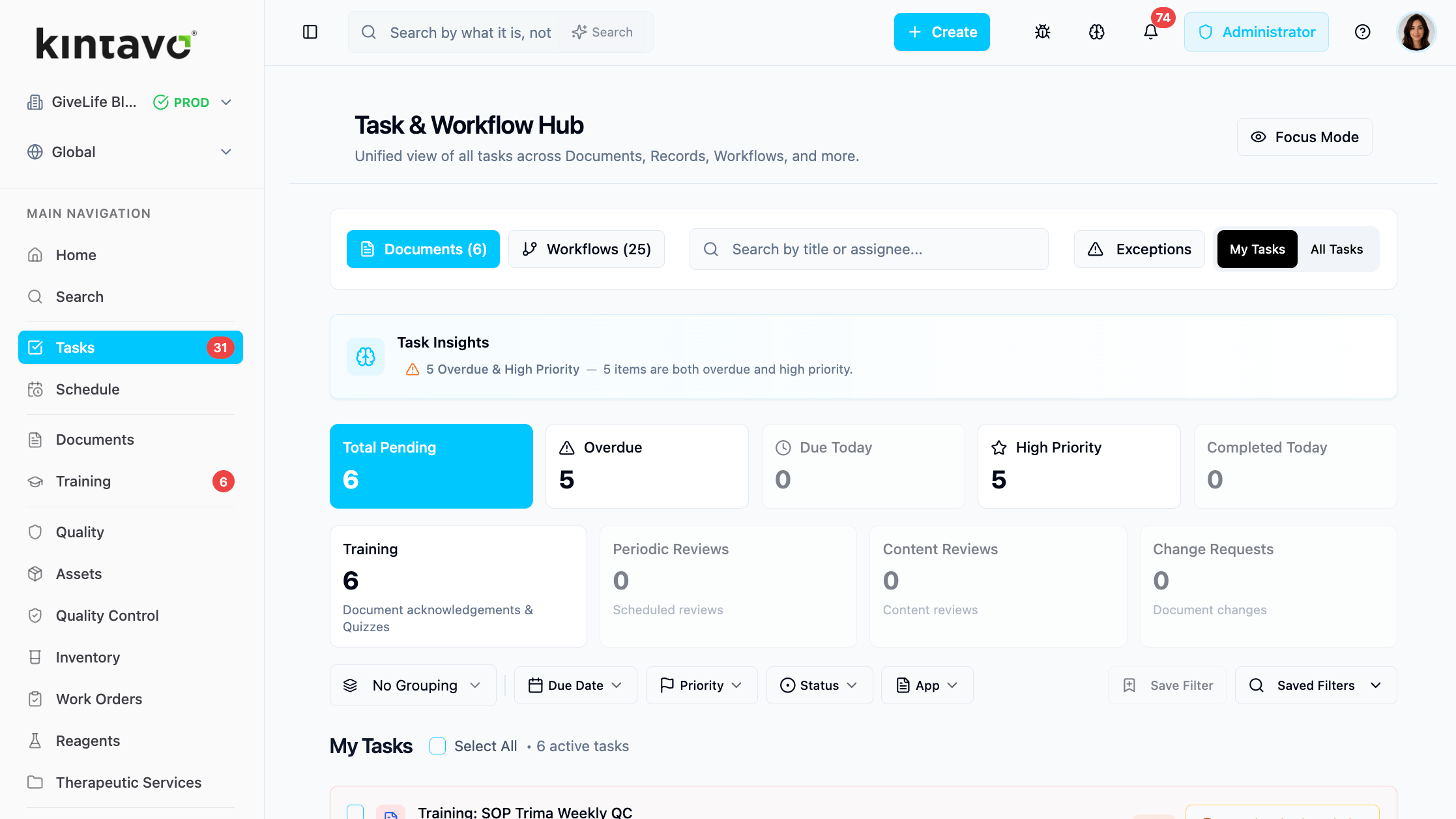
Compliance coverage for clinical laboratory quality management.
CLIA personnel records, CAP checklists, proficiency testing, and method validation — all under one roof.
Clinical Laboratory Improvement Amendments — federal certification for all human laboratory testing.
College of American Pathologists accreditation checklists and inspection requirements.
Medical laboratory quality and competence requirements.
Commission on Office Laboratory Accreditation for physician office labs.
FDA electronic records and signatures for regulated test functions.
Centers for Medicare & Medicaid Services — billing and laboratory survey requirements.
Security and availability controls for laboratory information systems.
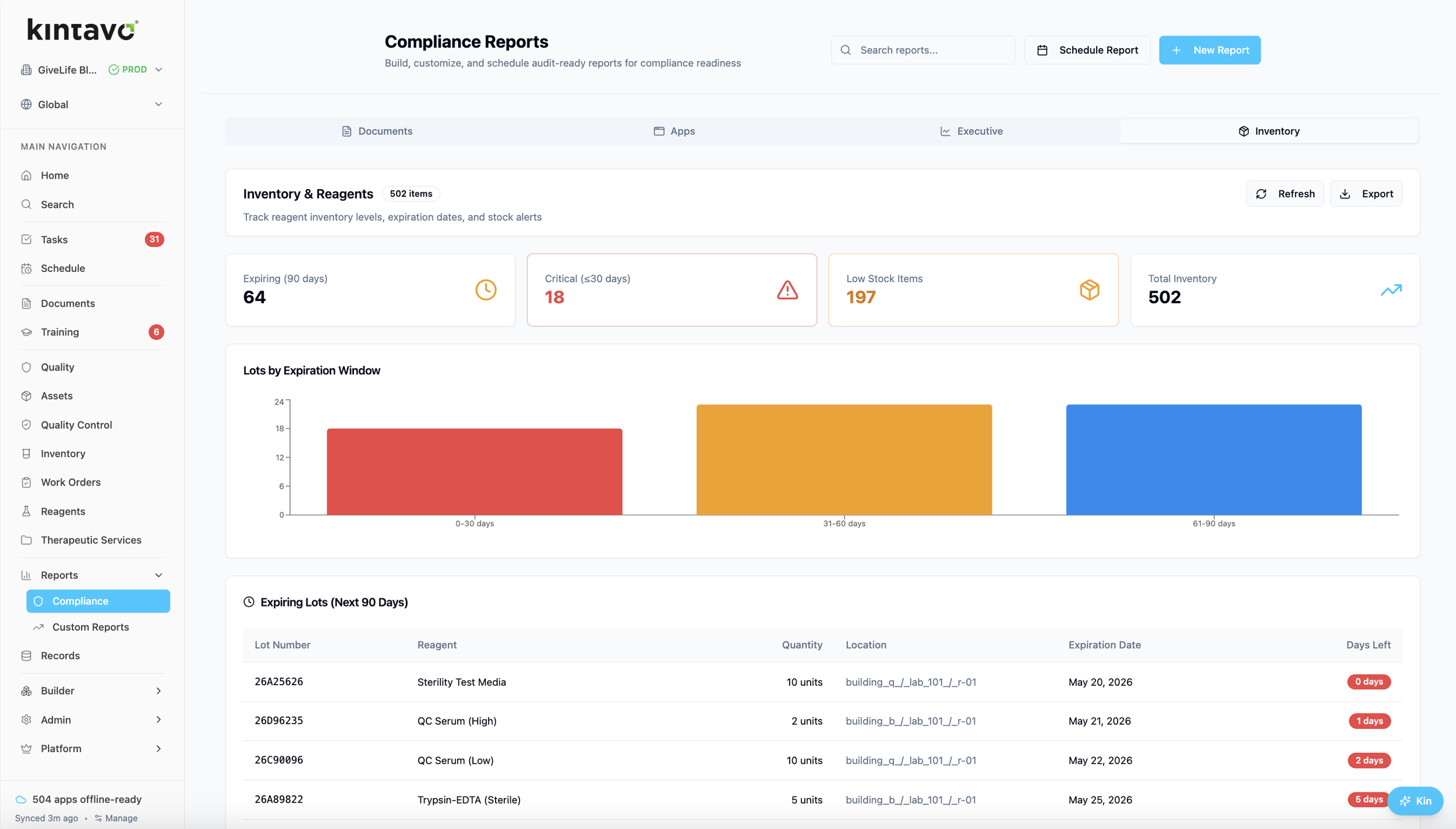
QC trends across analyzers — before they drift OOS.
Real-time Levey-Jennings, Westgard rule violations, and cross-instrument comparison.
When your laboratory runs on Kintavo.
QC, training, equipment, and proficiency testing stop living in spreadsheets and start living in the same record.
QC trends surface across analyzers before they drift out of spec.
Proficiency testing rounds tie to the analysts who ran them.
Method validation packets stay current with the instruments they cover.
CAP inspection prep is a query, not a binder hunt.
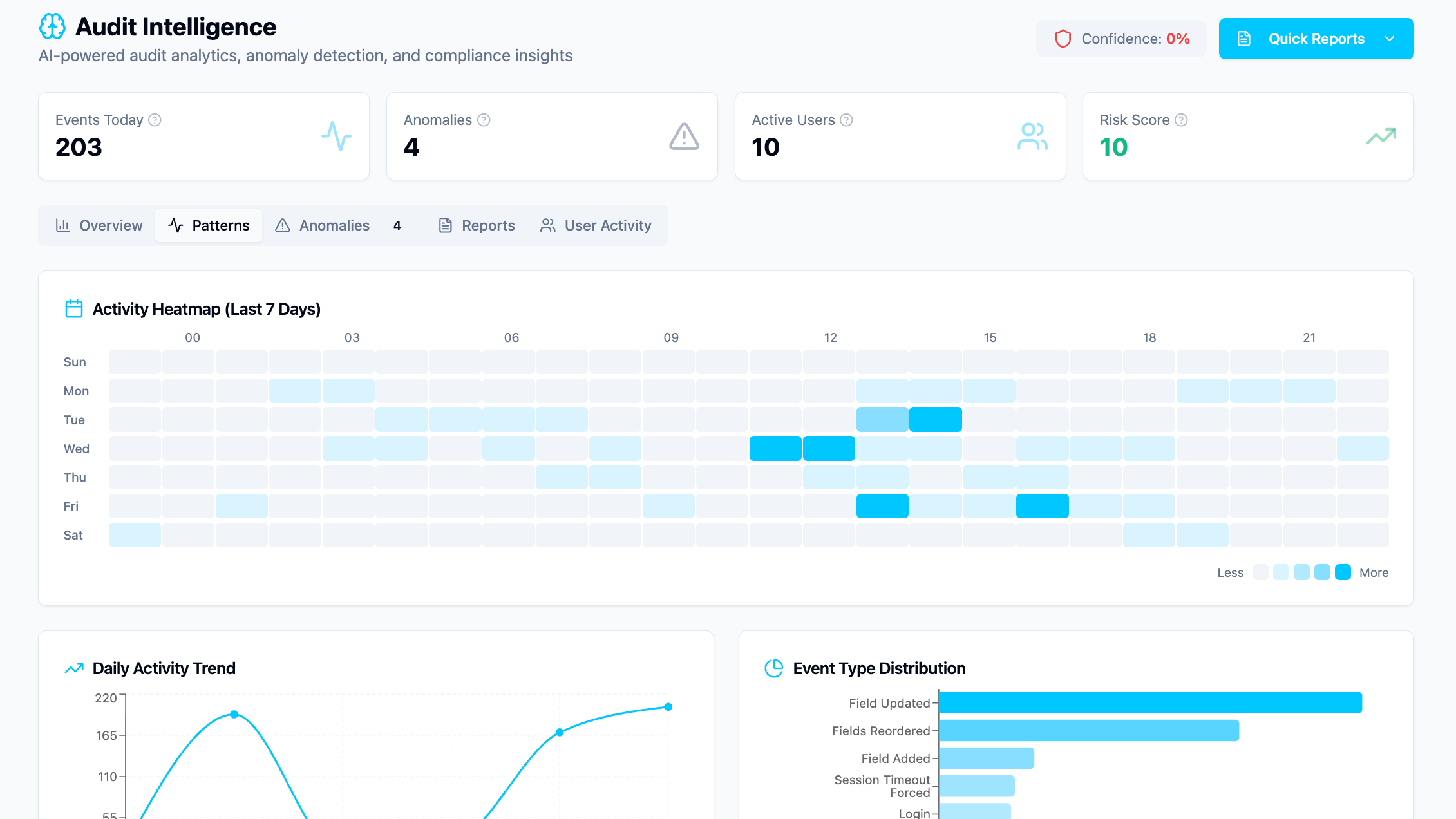
Your lab director stops chasing paper trails and starts running quality programs. The accreditation cycle becomes a continuous state — not an annual fire drill.
Book your demoFAQ Questions & Answers
Q: Is Kintavo designed specifically for clinical laboratories?
Kintavo is built for regulated quality environments and is configured for the specific requirements of clinical laboratories — CLIA, CAP, ISO 15189, and state licensing. The QC Analysis module supports Westgard multirule monitoring by analyte and instrument. Calibration Tracking manages instrument qualification and drift detection. Training Management ties records to specific procedure versions. The platform reflects how clinical laboratory quality programs actually work, not how generic QMS software assumes they do.
Q: How does Kintavo support CLIA compliance?
Kintavo's QC Analysis module captures QC results by analyte and instrument, applies configurable Westgard rules, and flags warning and rejection conditions automatically. Calibration records, instrument maintenance logs, and personnel training records are all maintained in a single system with 21 CFR Part 11 compliant electronic signatures and time-stamped audit trails. When a CLIA inspector asks for QC records, calibration history, or training documentation for a specific analyst, the complete record set is retrievable in seconds.
Q: How does Kintavo support CAP accreditation?
Kintavo's Audit Intelligence™ can be configured against CAP checklist requirements, continuously monitoring your laboratory's quality records for gaps that would generate a CAP finding. Pre-inspection reports identify open items mapped to specific checklist numbers before a CAP inspector arrives. Document Control maintains proficiency testing records, QC policies, and procedure manuals under version control. Training Management ensures every analyst is current on the procedures they perform. CAP survey preparation that used to take weeks takes hours.
Q: Can Kintavo manage QC across multiple instruments running the same method?
Yes. QC records in Kintavo are organized by analyte, instrument, and method. You can view Levey-Jennings data and Westgard rule violations at the method level across all instruments, or filter to a single analyzer. This makes it straightforward to distinguish instrument-specific problems from reagent lot issues or method-level bias — and to compare performance across instruments running the same assay. Cross-instrument trending is visible in the QA dashboard without pulling separate reports for each analyzer.
Q: How does Kintavo handle out-of-tolerance calibration results?
When an instrument calibration result falls outside defined acceptance criteria, Kintavo can automatically initiate a deviation record pre-populated with the instrument details, the out-of-tolerance result, and the date of the last passing calibration. The instrument can be flagged out of service. The lookback window — the period of patient results potentially affected — is calculated from the last passing calibration event and surfaced immediately for impact assessment. The full chain from out-of-tolerance result through deviation investigation through corrective action is captured in one traceable record.
Q: How does training management work when a laboratory procedure changes?
When a controlled procedure document is revised and approved in Kintavo, the system identifies every analyst whose role requires training on that procedure and automatically assigns a training task linked to the new version. The training task requires a read-and-understood acknowledgment with a 21 CFR Part 11 electronic signature. Analysts who have not completed training on the new version are flagged as overdue. Kintavo also supports configurable competency assessment questions tied to the document content.
Q: Can Kintavo manage proficiency testing records?
Yes. Proficiency testing participation, results, and corrective actions for failed PT events are managed within Kintavo alongside your internal QC records. PT event documentation — enrollment confirmations, result reports, peer comparison data, and corrective action responses — can be uploaded directly to the relevant accreditation record. When a CAP or CLIA surveyor asks for PT documentation, the complete history is retrievable from the same system as your internal quality records rather than from a separate filing system.
Q: How does Kintavo handle deviation reporting for clinical laboratory events?
Clinical laboratory deviations — out-of-specification QC results, instrument malfunctions, reagent failures, specimen processing errors, and proficiency testing failures — are captured in a structured workflow with required fields by event type. Each deviation record is linked to the instrument, reagent lot, procedure, and analyst involved. The investigation workflow enforces root cause documentation and impact assessment before closure. When a deviation warrants a CAPA, Kintavo initiates it directly from the deviation record with the event context pre-populated.
Q: Can Kintavo support multi-site laboratory networks?
Yes. Hospital-based laboratories, reference laboratories, and ambulatory laboratory outreach sites can all be managed under one Kintavo tenant with site-specific permissions, workflow configurations, and reporting. Each site sees the records relevant to its operations. QA leadership sees consolidated metrics across all sites. Cross-site trending — identifying the same instrument model failing at multiple locations or a shared reagent lot affecting results across facilities — is visible from the central dashboard.
Q: Is Kintavo 21 CFR Part 11 compliant for laboratory records?
Yes. Every record in Kintavo — QC results, calibration events, training completions, deviation records, CAPA closures — is captured with a time-stamped, user-attributed electronic signature that meets 21 CFR Part 11 and EU Annex 11 requirements. The audit trail is immutable and exportable. For laboratories operating under both CLIA and FDA oversight, your electronic records will satisfy both frameworks from the same system.
Q: What does implementation look like for a clinical laboratory?
Your implementation lead works with your laboratory quality team to configure analytes, instruments, QC rules, calibration schedules, procedure document library, training curricula, and deviation workflows — typically within the first two to three weeks of onboarding. Historical QC data, calibration records, and training logs can be migrated from spreadsheets or prior systems. Most laboratories are processing live QC data, calibration events, and deviation records in Kintavo within 30 days of kickoff.
Laboratory quality lives in too many places.
CLIA personnel records in one system. CAP checklists in spreadsheets. QC data trapped in the LIS. Calibration logs on the bench. Proficiency testing rounds in email. Equipment service records in a binder — somewhere.
Each accreditation cycle becomes an archaeology project — finding the evidence, reconstructing the trail, hoping the gaps don't show. Kintavo replaces the archaeology with a system that already has the answer.