
Quality management built for the regulatory precision of blood banking and transfusion medicine
Blood banks and transfusion services operate under some of the strictest regulatory frameworks in healthcare — AABB standards, FDA 21 CFR 606, CLIA, and CAP simultaneously. Kintavo gives blood bank and transfusion service quality teams a single platform to manage donor records, component testing QC, equipment qualification, deviation investigation, and accreditation readiness — connected in one system, without reconstructing the audit trail from five separate places every time an inspector arrives.
One platform for every quality domain a blood bank operates under.
AABB, FDA biologics, and ISBT 128 — donor to disposition, in one system of record.
Document Control
Controlled SOPs for collection, component preparation, testing, labeling, storage, and transfusion — with revision history that survives an inspection.
Learn moreDeviation Management
Structured capture for collection deviations, component nonconformances, transfusion reactions, and look-back triggers.
Learn moreCAPA Management
Root-cause and corrective action workflows for biological product deviations, regulatory observations, and adverse outcomes.
Learn moreTraining Management
Competency tracking for collection staff, processing techs, MLSs, and transfusion-service personnel — every procedure, every renewal.
Learn moreEquipment Management
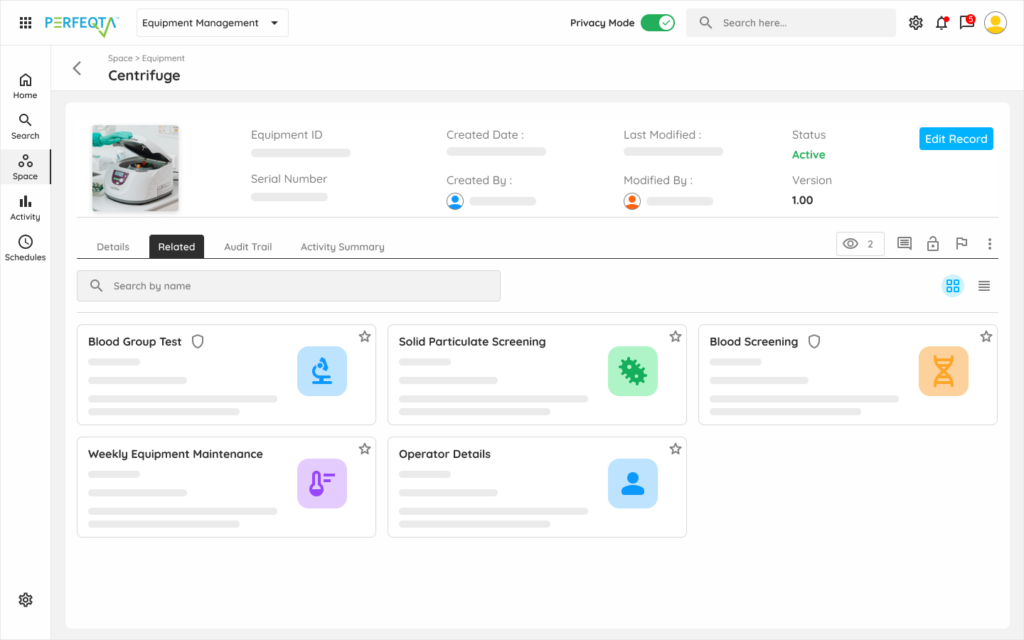
Apheresis machines, freezers, irradiators, agglutination viewers — qualification and PM records for the full equipment census.
Learn moreQC Analysis
Daily QC for typing reagents, component yields, and storage temperature compliance.
Learn moreAudit Management
AABB assessment
Compliance coverage for blood bank and transfusion service operations.
Biologics regulation, voluntary accreditation, and labeling standards — all under one system of record.
Association for the Advancement of Blood & Biotherapies standards for blood banks and transfusion services.
FDA Current Good Manufacturing Practice for blood and blood components.
FDA requirements for blood and blood components intended for transfusion or further manufacturing.
International information standard for blood and tissue product labeling.
FDA electronic records and signatures for regulated biologics functions.
Biologics License Application compliance for licensed establishments.
Security and availability controls for donor and patient data.
Chain of identity, donor to disposition.
Every unit links to the donor, the deviations on its lot, and the recipient who received it.
When your blood bank runs on Kintavo.
Donors, deviations, testing, and transfusion records share a single chain of identity — instead of four disconnected ones.
Deviations route the same way whether they're collection, processing, or transfusion related.
ISBT 128 labeling stays current with the codes ICCBBA released last month.
Look-back investigations pull every linked record in a single query.
AABB assessment prep is a button, not a binder.
Your medical director and quality manager work from the same record — not from email threads and reconciled spreadsheets. Compliance becomes an attribute of the workflow, not a separate job.
Book your demoFAQ Questions & Answers
Q: Is Kintavo built specifically for blood bank and transfusion service quality programs? Kintavo is configured for the specific regulatory requirements of blood banks and transfusion services — AABB standards, FDA 21 CFR 606 and 630, CLIA, and CAP. Document Control manages SOPs for collection, component preparation, testing, labeling, storage, and transfusion under version control with automatic training linkage. Deviation Management captures nonconformances with structured investigation workflows. Equipment Management tracks qualification and maintenance for apheresis machines, freezers, and irradiators. The platform reflects how blood bank quality programs actually operate under multi-framework oversight.
Q: How does Kintavo support AABB accreditation? Kintavo's Audit Intelligence™ can be configured against AABB Standards requirements, continuously monitoring your quality records for gaps that would generate an AABB finding. Pre-inspection reports identify open items — overdue calibrations, training lapses, unresolved deviations, open CAPAs — mapped to specific AABB Standards before an assessor arrives. Document Control maintains your quality manual, SOPs, and training records under version control. The full quality system evidence package that used to take weeks to compile before an AABB assessment is retrievable in hours.
Q: How does Kintavo support FDA 21 CFR 606 compliance? FDA 21 CFR 606 requires blood establishments to maintain complete records of all manufacturing steps, equipment performance, and personnel qualifications. In Kintavo, every record — component testing QC, equipment calibration, personnel training, deviation investigations, and CAPA closures — is captured with a time-stamped, user-attributed audit trail that meets 21 CFR Part 11 electronic signature requirements. When an FDA investigator requests records during a biennial inspection, the complete manufacturing record for any unit or date range is retrievable without manual reconstruction.
Q: How does Kintavo handle look-back and recall events? When a deviation, donor deferral, or regulatory notification triggers a look-back requirement, Kintavo's 360° Compliance Map™ surfaces every component record linked to the relevant donor, lot, or equipment event. The complete chain — from the triggering event through component disposition — is traceable in one view. CAPA records can be initiated from look-back findings and tracked through corrective action and effectiveness verification. The look-back record, including all linked component dispositions, is exportable for FDA reporting or AABB documentation.
Q: How does Kintavo handle deviations specific to blood banking? Blood bank deviations — donor deferral errors, component labeling discrepancies, testing equipment failures, cold chain excursions, and transfusion reactions — are captured in structured workflows with required fields by event type and severity. Each deviation record is linked to the equipment, reagent lot, procedure, and personnel involved. Investigation workflows enforce root cause documentation and impact assessment — including assessment of affected units — before closure. When a deviation warrants regulatory reporting, Kintavo routes the record through a reporting review workflow before closure.
Q: Can Kintavo manage transfusion service records separately from blood bank manufacturing records? Yes. Kintavo supports separate workflow configurations for blood bank manufacturing operations and transfusion service clinical operations within the same tenant. Each area can have its own SOPs, training curricula, deviation categories, equipment records, and QC programs — with separate role-based access — while sharing the same compliance infrastructure and reporting to quality leadership through one dashboard. Organizations that operate both a donor center and a hospital transfusion service can manage both under one platform.
Q: How does equipment management work for blood bank-specific equipment? Blood bank equipment — apheresis machines, refrigerators, freezers, platelet agitators, irradiators, cell washers, and testing analyzers — can all be managed in Kintavo's Equipment Management module with qualification records (IQ/OQ/PQ), calibration schedules, preventive maintenance workflows, and temperature monitoring linkage. When equipment goes out of specification — a refrigerator temperature excursion, for example — Kintavo can initiate a deviation automatically and flag the affected inventory for review. The complete equipment history for any asset is retrievable in seconds for an FDA inspection.
Q: How does QC Analysis work for blood bank testing? Kintavo's QC Analysis module captures daily QC for typing reagents, component yield testing, and storage temperature compliance. Configurable Westgard rules flag warning and rejection conditions automatically across instruments. Blood bank testing platforms — serologic analyzers, NAT systems, and automated crossmatch equipment — can each have their own QC schedules, acceptance criteria, and alert thresholds. Cross-instrument trending surfaces bias or drift patterns before a testing failure occurs during a donor or patient run.
Q: Can Kintavo support multi-site blood bank and transfusion networks? Yes. Regional blood centers with multiple donor collection sites, processing facilities, and hospital distribution points can all be managed under one Kintavo tenant with site-specific permissions, workflow configurations, and reporting. Each facility sees the records relevant to its operations. Quality leadership sees consolidated metrics across all sites. Cross-site trending — identifying the same equipment model generating nonconformances at multiple locations, or a shared reagent lot affecting QC at multiple facilities — is visible from the central dashboard without pulling separate reports from each location.
Q: Is Kintavo compliant with 21 CFR Part 11 for blood establishment records? Yes. Every record in Kintavo — component testing QC, equipment logs, training completions, deviation records, CAPA closures, and donor record-related quality events — is captured with a time-stamped, user-attributed electronic signature that meets 21 CFR Part 11 requirements. The audit trail is immutable and exportable. For blood establishments required to maintain electronic records under FDA oversight, Kintavo's record system satisfies the predicate rule requirements of 21 CFR 606 and the electronic signature requirements of 21 CFR Part 11 from the same platform.
Q: What does implementation look like for a blood bank or transfusion service? Your implementation lead works with your blood bank quality team to configure deviation categories, equipment records, QC programs, document libraries, training curricula, CAPA workflows, and AABB/FDA framework mappings — typically within the first two to three weeks of onboarding. Existing SOPs, equipment records, and open deviation and CAPA records can be migrated from spreadsheets or prior systems. Most blood banks have their quality program live and processing real deviations, QC data, and equipment records in Kintavo within 30 days of kickoff.
Blood banking sits at an intersection few systems were built for.
FDA biologics regulation. AABB voluntary accreditation. ISBT 128 labeling. State health department oversight. Hospital-level integration with the EMR and LIS. A single nonconformance can trigger reporting requirements from four different regulators.
Managing that on disconnected tools — paper logs, vendor BBIS, separate QMS — is how look-back failures happen. Kintavo is the system of record those handoffs no longer have to leave.