ISO 15189: What Medical Laboratories Need to Know Now
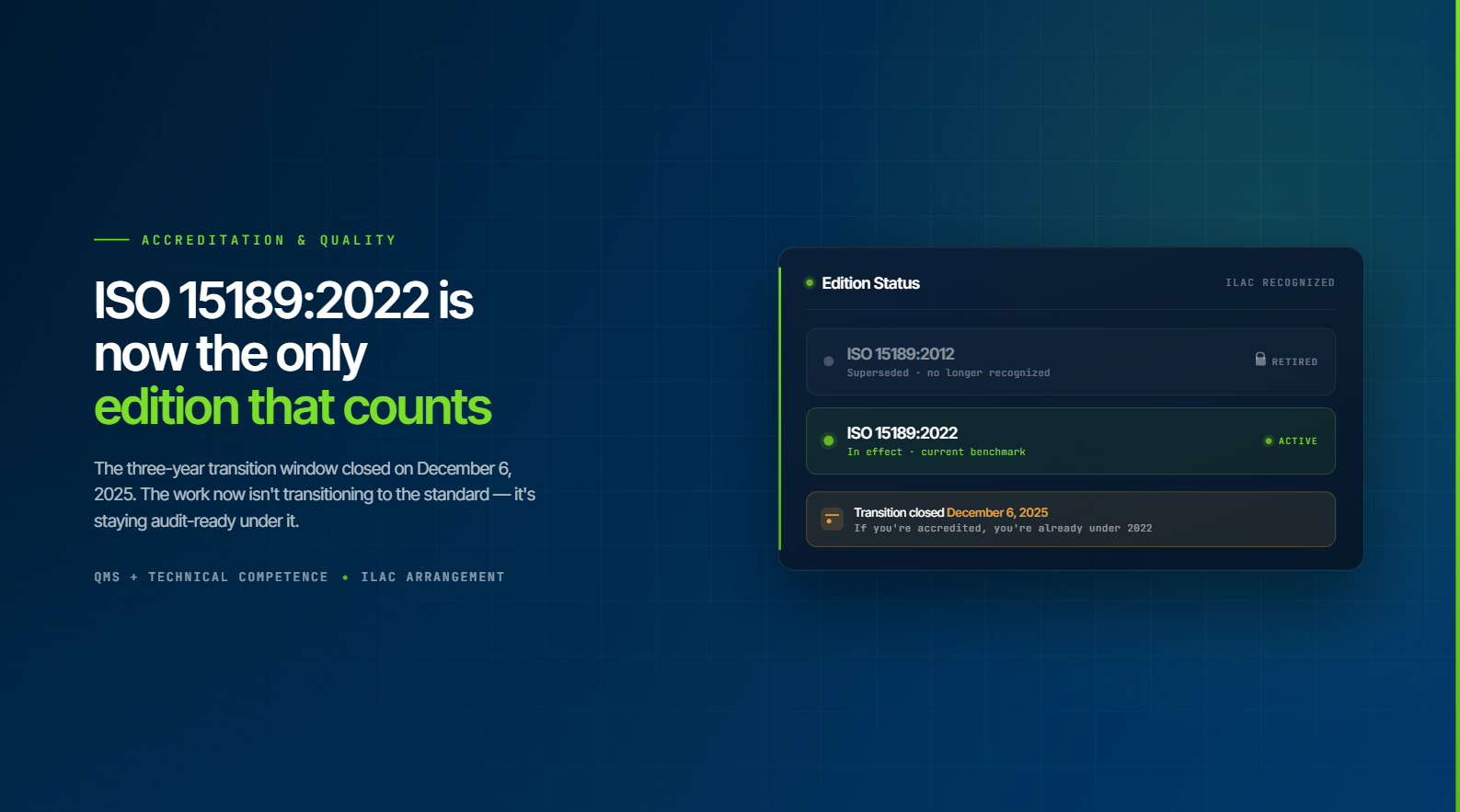
For two decades, ISO 15189 has been the international benchmark for quality and competence in medical laboratories. The current edition, ISO 15189:2022, is now the only version that counts. The three year transition window closed on December 6, 2025, which means accreditation to the older 2012 edition is no longer recognized under the ILAC Arrangement. If your lab is accredited, it is already operating under the 2022 requirements.
So the work now is not transitioning to the standard. It is staying audit ready under it. Here is what the 2022 edition asks of your lab, what actually changed from 2012, where teams keep slipping, and how to keep compliance from becoming a fire drill before every assessment.
What ISO 15189 actually covers
ISO 15189 sets requirements for both the quality management system and the technical competence of medical laboratories. That combination is the point. A lab can have immaculate paperwork and still produce unreliable results, or run excellent science on top of a quality system that falls apart under inspection. The standard exists to make sure neither happens on its own.
It applies to labs developing or maintaining a management system, and to the accreditation bodies, regulators, and lab users who need to confirm a lab's competence. The 2022 edition also folded point of care testing directly into scope, which used to sit under its own standard.
What changed from the 2012 edition
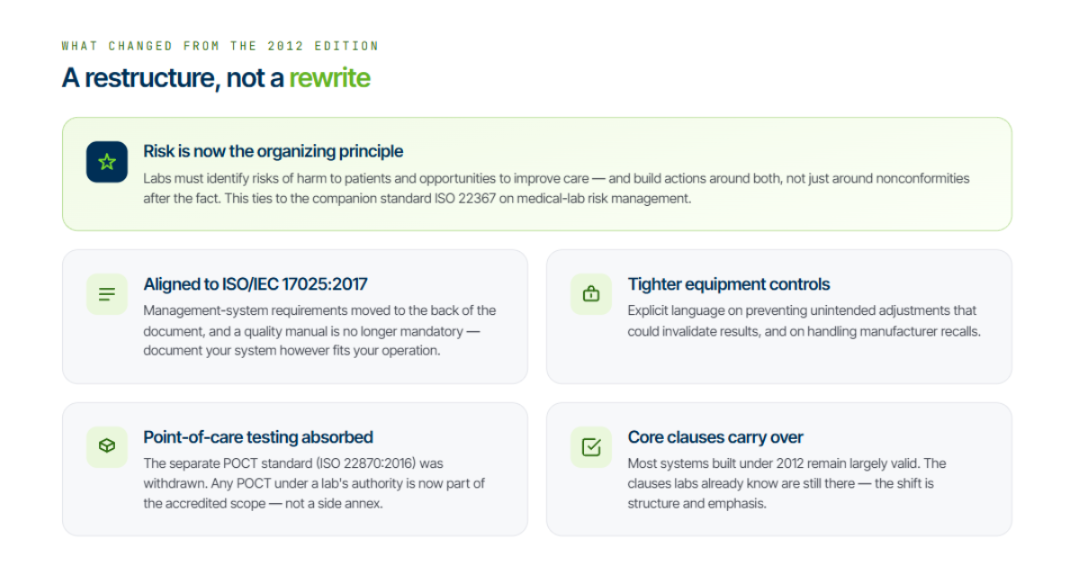
The revision was not a rewrite. Most existing quality systems built under the 2012 edition remain largely valid, and the core clauses that labs already know are still there. What moved is structure and emphasis.
The document was restructured to align with ISO/IEC 17025:2017, the parent standard for testing and calibration labs, which pushed the management system requirements to the back of the document rather than the front. A quality manual is no longer mandatory. Labs can document their management system however makes sense for their operation, as long as the substance is there.
The bigger shift is risk. ISO 15189:2022 requires labs to identify risks of harm to patients and opportunities to improve care, and to build actions around both, not just around nonconformities after the fact. That requirement is tied to a companion standard, ISO 22367, on risk management specific to medical labs. Equipment requirements got more specific too, with explicit language on preventing unintended adjustments that could invalidate results and on handling manufacturer recalls.
Point of care testing is the other major addition. The separate POCT standard, ISO 22870:2016, was withdrawn and its requirements were absorbed directly into ISO 15189:2022. Any point of care testing performed under a lab's authority is now part of the accredited scope, not a side annex.
Where labs actually struggle
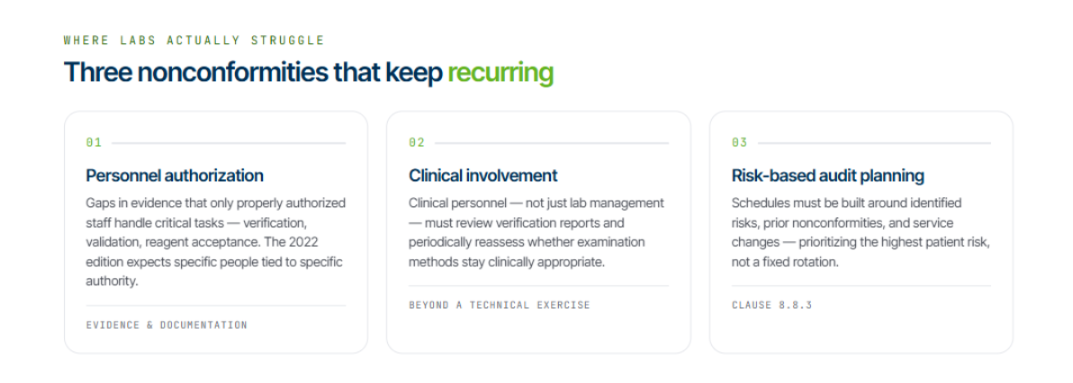
Accreditation bodies running transition assessments have been tracking nonconformity trends since 2024, and the pattern has held steady. Three areas keep showing up.
The first is personnel authorization. Assessors are finding gaps in evidence that only properly authorized staff are handling critical tasks like verification, validation, and reagent acceptance. The requirement existed before, but the 2022 edition expects clearer documentation tying specific people to specific authority.
The second is clinical involvement. The new standard expects clinical personnel, not just lab management, to be reviewing verification reports and periodically reassessing whether examination methods are still clinically appropriate. Labs that historically ran this as a purely technical exercise are the ones getting flagged.
The third is risk based audit planning. Clause 8.8.3 requires audit schedules built around identified risks, prior nonconformities, and service changes, prioritizing whatever carries the highest risk to patients. A lot of labs are still running audit calendars on a fixed rotation instead of a risk model, and that gap shows up quickly in assessment.
None of these are exotic requirements. They are documentation and evidence problems, which is exactly the kind of gap that shows up the moment records live in five different places instead of one connected system.
Where the US fits in
Worth being direct about this since it gets muddled. In the United States, ISO 15189 accreditation is voluntary. No federal or state regulator requires it. CLIA is the mandatory floor for any lab accepting human specimens, and ISO 15189 accreditation does not replace CLIA certification under any circumstance. CAP accreditation is separate again, and CAP requires a lab to already hold CAP LAP accreditation before it can pursue CAP 15189.
That said, plenty of US labs pursue ISO 15189 anyway, because it forces a more rigorous management system than CLIA alone requires, and because it signals a level of quality maturity that matters for research partnerships, international sample work, and payer or provider relationships. If your lab is CLIA certified, CAP accredited, and also holds or is pursuing ISO 15189, the practical reality is you are running three sets of requirements that overlap heavily but are not identical. That is a lot to track by hand.
Staying audit ready without the scramble
The labs that come through assessments cleanly are not the ones with more meetings about compliance. They are the ones where evidence already exists in the normal course of work and just needs to be pulled.
That means training records that are automatically linked to the SOP version active at the time someone was trained, not reconstructed after the fact. It means equipment and calibration history that ties directly to the examinations run on that equipment. It means CAPA and risk records that connect back to the specific process or method they affect, so a risk based audit schedule is something you can actually generate from your own data instead of assembling from memory.
Kintavo is built around that connection. Document control, training and competency records, equipment and calibration tracking, risk management, and CAPA all live in one system instead of five, which means the evidence an assessor asks for is already assembled before they ask for it.
Frequently asked questions
Is ISO 15189:2012 accreditation still valid?
No. The three year transition period closed on December 6, 2025. Accreditation to the 2012 edition is no longer recognized under the ILAC Arrangement.
Is ISO 15189 required for US medical laboratories?
No. It is voluntary. CLIA certification is the legal requirement for any lab accepting human specimens, and ISO 15189 does not substitute for it.
What is the biggest change in ISO 15189:2022?
The strongest new emphasis is on risk management, tied to the companion standard ISO 22367, along with the direct incorporation of point of care testing requirements that used to sit in a separate standard.
Does ISO 15189:2022 cover point of care testing?
Yes. The 2022 edition folded in the requirements from ISO 22870:2016, which was withdrawn. Point of care testing performed under a lab's authority is now part of the accredited scope.