
Quality management built for the chain of custody demands of tissue and organ programs
Tissue banks and transplant programs operate under a regulatory and ethical obligation that few other industries share — AATB accreditation, 21 CFR 1271, UNOS/OPTN policies, and state anatomical gift laws simultaneously, with families and recipients trusting that the chain of custody from donor to transplant held at every step. Managing that on paper logs and disconnected databases is how mistakes happen. Kintavo gives tissue and organ program quality teams a single platform where chain of custody is structural — donor eligibility, recovery, processing, distribution, and transplant disposition connected in one traceable record, with adverse-event reporting that routes to AATB, FDA, and UNOS from a single entry.
One platform for every quality domain a tissue program operates under.
Tissue banks, transplant programs, and biorepository compliance — built for the chain of custody these programs demand.
Document Control
Recovery, processing, and distribution SOPs with version-linked training and donor consent documentation.
Learn moreDeviation Management
Structured deviation capture for recovery, processing, distribution, and adverse-outcome events.
Learn moreCAPA Management
Corrective action workflows linked to AATB and FDA observation responses.
Learn moreTraining Management
Recovery technician, processor, and distribution staff competency tracking.
Learn moreEquipment Management
Freezers, controlled-rate freezers, processing equipment, and ambient-temperature monitoring.
Learn moreSupplier Quality
Reagent vendor qualification, courier service contracts, and contracted processor oversight.
Learn moreAudit Management
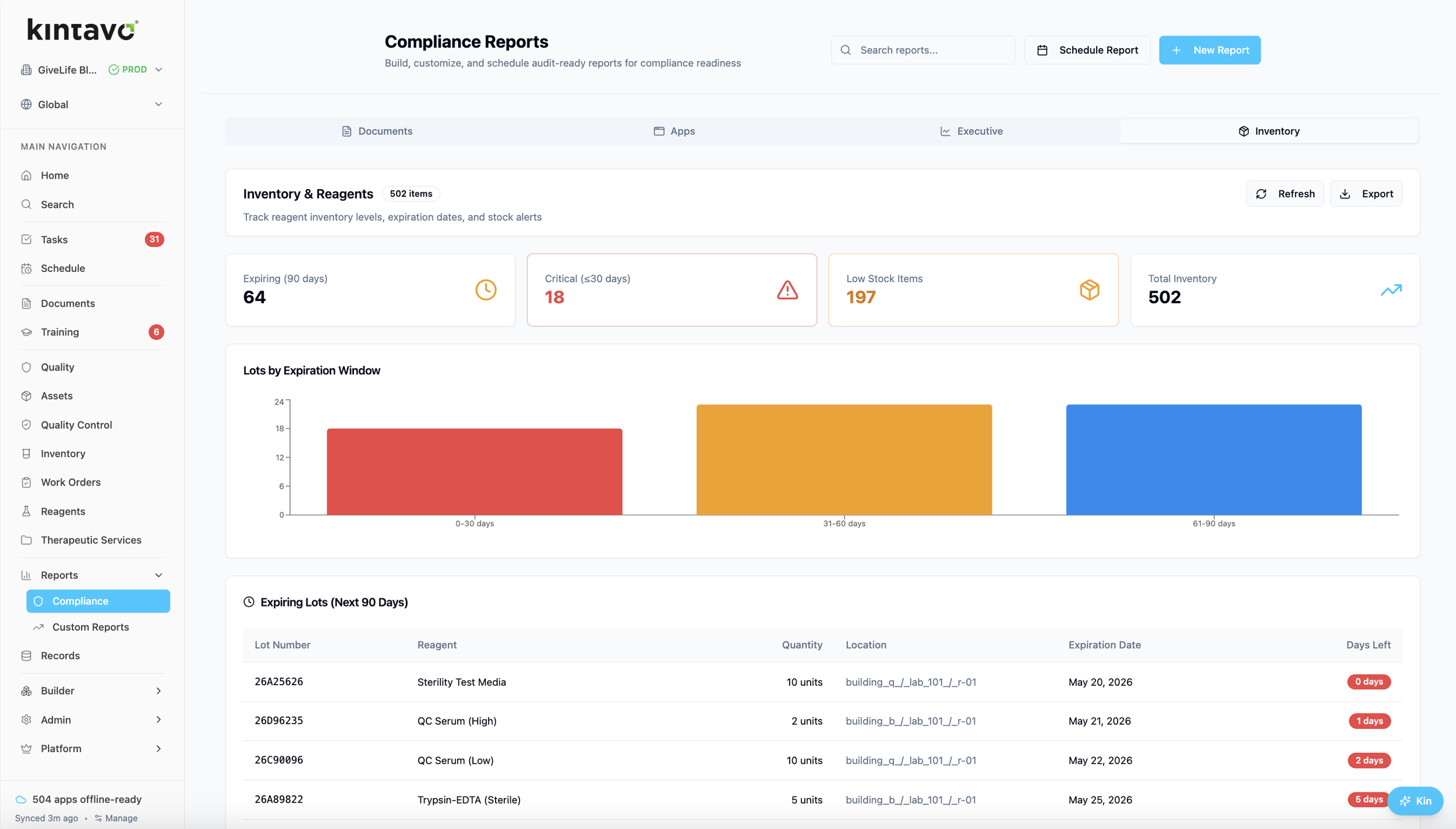
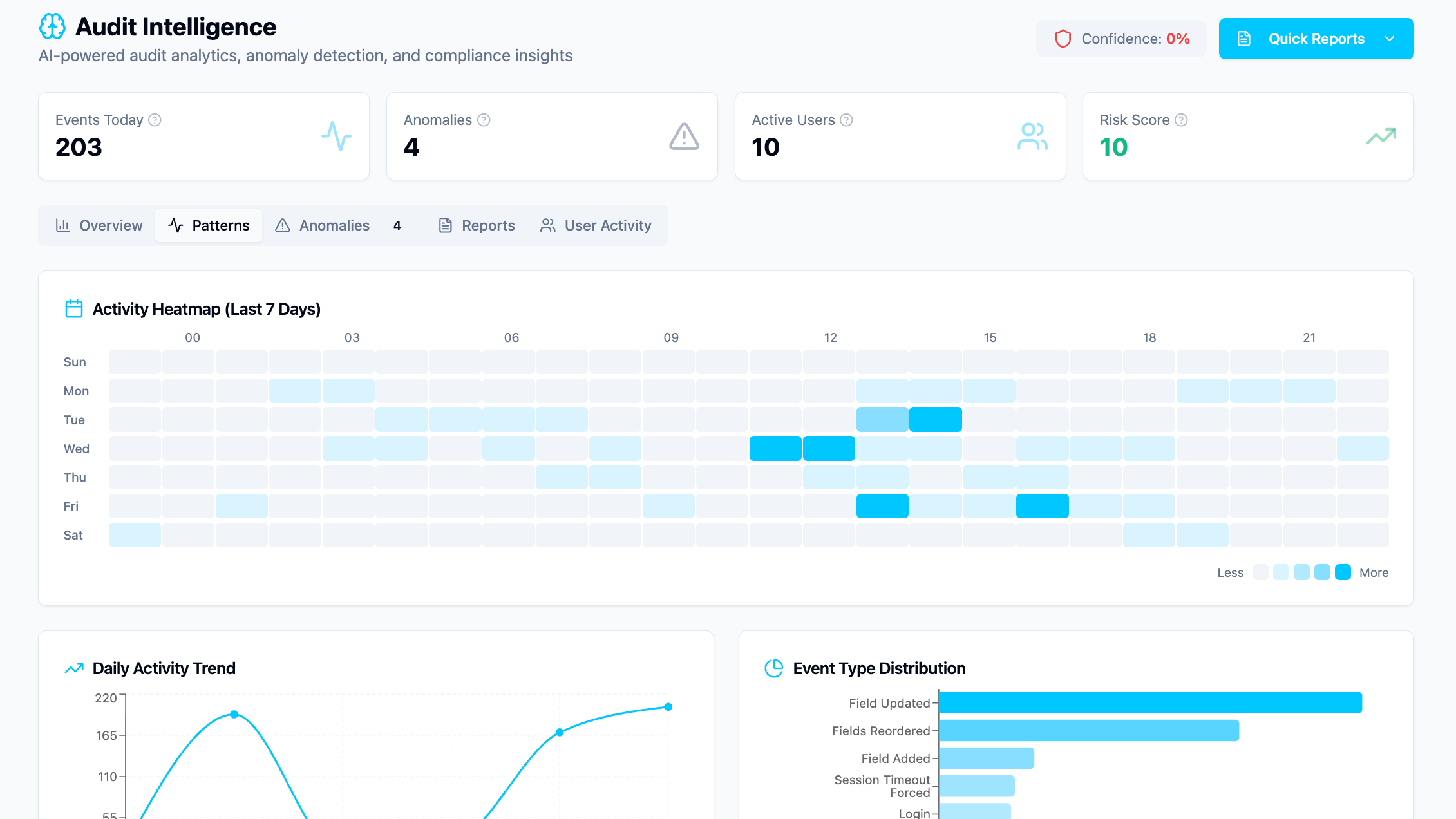
AATB accreditation cycles, FDA inspections, and UNOS site surveys — continuous, not seasonal.
Learn moreRisk Management
Donor eligibility, infectious disease risk, and chain-of-custody risk identification.
Learn more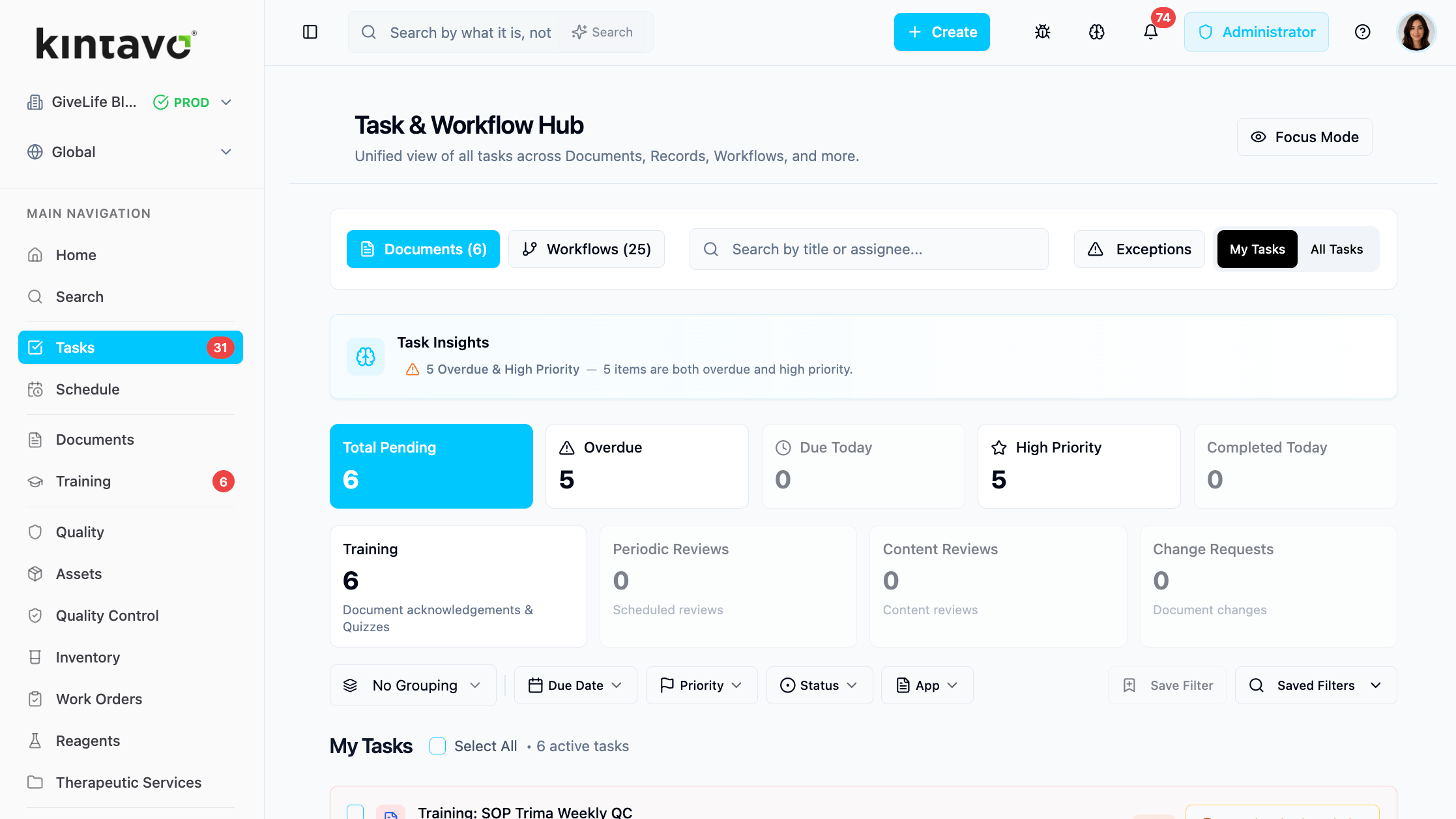
Compliance coverage for tissue and transplant programs.
AATB accreditation, FDA biologics regulation, and UNOS/OPTN policies — all under one record.
American Association of Tissue Banks accreditation standards.
FDA HCT/P regulation — donor eligibility, recovery, processing, and distribution.
Organ Procurement and Transplantation Network policies and reporting.
Foundation for the Accreditation of Cellular Therapy standards for cord blood and cellular products.
Medical laboratory quality for HLA and donor screening labs.
FDA electronic records and signatures.
Security and availability controls for donor and recipient data.
Chain of custody, every handoff.
Recovery to transplant — every touchpoint, every signature, every temperature reading.
When your tissue program runs on Kintavo.
Chain of custody is structural. Adverse-event reporting routes once and lands in three regulators' inboxes. Inspection-ready means it.
Chain of custody survives every handoff — recovery, processing, distribution, transplant.
Donor eligibility links to the screening results that established it.
Adverse-event reporting routes to AATB, FDA, and UNOS from one entry.
Inspection-ready means inspection-ready — not "we have a binder somewhere."
Your recovery, processing, and distribution teams work from one record — the one the donor family and the transplant recipient are trusting you to keep. That is what the platform is for.
Book your demoFAQ Questions & Answers
Q: Is Kintavo built for tissue bank and transplant program quality management? Kintavo is configured for the specific compliance requirements of tissue banks and transplant programs — AATB accreditation standards, 21 CFR 1271, UNOS/OPTN policies, and 21 CFR Part 11 simultaneously. Document Control manages SOPs for recovery, processing, and distribution under version control with automatic training linkage and donor consent documentation. Deviation Management captures nonconformances across the full donor-to-recipient workflow. Chain-of-custody tracking connects every handoff from donor eligibility determination through transplant disposition. The platform is built so chain of custody is structural — not reconstructed from paper logs after something goes wrong.
Q: How does Kintavo support AATB accreditation? Kintavo's Audit Intelligence™ can be configured against AATB Standards requirements, continuously monitoring your quality records for gaps that would generate an AATB finding. Pre-accreditation reports identify open items — overdue training renewals, unresolved deviations, open CAPAs, equipment qualification lapses — mapped to specific AATB Standards before an assessor arrives. Document Control maintains your quality manual, SOPs, and training records under version control. The full quality system evidence package for AATB accreditation and re-accreditation is retrievable in hours rather than weeks of manual compilation.
Q: How does Kintavo support 21 CFR 1271 compliance for HCT/Ps? 21 CFR 1271 requires tissue establishments to maintain records demonstrating donor eligibility, recovery procedures, processing controls, distribution tracking, and adverse-reaction investigation — all with the documentation and audit trail required for FDA inspection. In Kintavo, every record from donor eligibility screening through transplant disposition is captured with a time-stamped, user-attributed audit trail that meets 21 CFR Part 11 electronic signature requirements. When an FDA investigator requests records during an inspection, the complete tissue-lot history — from donor screening results through recipient disposition — is retrievable without manual reconstruction.
Q: How does chain-of-custody tracking work in Kintavo? Chain-of-custody in Kintavo is a connected record that links the donor, the eligibility determination, the recovery event, the tissue lot generated, every processing and QC step for that lot, cold-chain custody during distribution, and the transplant or disposition event — with required signatures and documented handoffs at each stage. At each transfer point, custody transfer is a required workflow step before the next stage proceeds. If a custody discrepancy or cold-chain excursion occurs at any point, a deviation initiates automatically and the affected lot is flagged for review. The complete chain-of-custody record for any tissue lot is retrievable in seconds for an AATB assessor or FDA inspector.
Q: How does Kintavo handle adverse event reporting across multiple regulators? Tissue-related adverse events — transplant-transmitted infections, graft failures attributable to processing, distribution temperature excursions affecting graft viability — often require concurrent reporting to AATB, FDA, and UNOS. In Kintavo, an adverse event triggers a single structured investigation workflow. The documentation generated from that investigation — root cause analysis, CAPA, corrective actions taken — is the same record that supports the reporting obligations to each regulatory body. Notification routing and documentation formatting can be configured per the requirements of each recipient. The complete adverse event record, including all reporting documentation, is maintained in the same system as the underlying quality records that generated it.
Q: How does donor eligibility management work in Kintavo? Donor eligibility records in Kintavo link the donor's infectious disease screening results, medical/behavioral history review, physical assessment findings, and the eligibility determination decision — with the signature of the designated Medical Director or qualified person who made the determination. When an eligibility determination is made, it links directly to the recovery record and any tissue lots generated from that donor. If a post-recovery screening result changes the eligibility status, Kintavo surfaces all tissue lots from that donor immediately for impact assessment and disposition decision. The complete eligibility record is retrievable for any donor at any time.
Q: How does equipment management work for tissue bank equipment? Tissue bank equipment — cryogenic freezers, controlled-rate freezers, liquid nitrogen dewars, processing biosafety cabinets, centrifuges, and ambient temperature storage — can all be managed in Kintavo's Equipment Management module with qualification records (IQ/OQ/PQ), calibration schedules, preventive maintenance workflows, and continuous temperature and environment monitoring linkage. When a freezer temperature excursion occurs, Kintavo can initiate a deviation automatically and flag all tissue lots in the affected unit for impact assessment and disposition. The complete equipment history for any asset is retrievable in seconds for an AATB or FDA inspection.
Q: How does training management work for recovery technicians and processors? Recovery technicians, processors, and distribution staff in Kintavo have role-based training curricula that assign automatically based on job function. When a recovery or processing SOP is revised and approved, training automatically assigns to every staff member whose role requires competency on that procedure. Training tasks require a 21 CFR Part 11 electronic signature acknowledgment. For procedures requiring demonstrated competency — aseptic technique, controlled-rate freezing, or chain-of-custody verification — supervisor sign-off captures the competency assessment in the same record as the training acknowledgment. When an AATB assessor asks for training records for the recovery technician who recovered a specific donor, the complete training history is retrievable immediately.
Q: How does Kintavo support UNOS/OPTN reporting requirements? UNOS/OPTN reporting requirements for organ procurement organizations and transplant centers include adverse event reporting, organ utilization documentation, and transplant outcome tracking. In Kintavo, the deviation and CAPA workflows that govern quality event investigation generate the documentation that supports UNOS/OPTN reporting obligations. Organ procurement and transplant disposition records can be configured to capture the data elements required for UNOS reporting. The complete organ record — from procurement through transplant outcome — is maintained in one traceable system rather than across disconnected databases and paper forms.
Q: Can Kintavo support multi-site tissue banking and transplant networks? Yes. Tissue banking organizations operating across multiple recovery regions, processing facilities, and distribution networks can be managed under one Kintavo tenant with site-specific permissions, workflow configurations, and reporting. Each site sees the records relevant to its operations. Quality leadership sees consolidated metrics across all sites. Cross-site trending — identifying recurring deviation patterns in recovery operations, or cold-chain excursions during distribution from specific courier routes — is visible from the central dashboard without requiring manual compilation from site coordinators.
Q: Is Kintavo 21 CFR Part 11 compliant for tissue establishment records? Yes. Every record in Kintavo — donor eligibility determinations, recovery documentation, processing records, QC release decisions, chain-of-custody transfers, deviation reports, CAPA closures, and training completions — is captured with a time-stamped, user-attributed electronic signature that meets 21 CFR Part 11 requirements. The audit trail is immutable and exportable. For tissue establishments required to maintain electronic records under FDA oversight, Kintavo's record system satisfies the predicate rule requirements of 21 CFR 1271 and the electronic signature requirements of 21 CFR Part 11 from the same platform.
Q: What does implementation look like for a tissue bank or transplant program? Your implementation lead works with your quality team to configure donor eligibility workflows, recovery and processing SOPs, deviation categories, training curricula, equipment records, chain-of-custody transfer workflows, AATB and 21 CFR 1271 framework mappings, and adverse-event reporting workflows — typically within the first two to three weeks of onboarding. Existing SOPs, donor records, and open quality records can be migrated from paper-based systems or disconnected databases. Most tissue programs are processing live quality events in Kintavo within 30 days of kickoff.
Tissue and organ programs run on a chain of custody few systems were designed for.
AATB accreditation. 21 CFR 1271. UNOS/OPTN policies. State anatomical gift laws. State licensure. And underneath all of it, the families and recipients who trust that nothing slipped.
Managing that on paper logs and disconnected databases is how mistakes happen — and these mistakes do not stay quiet. Kintavo is built so the chain of custody is structural, not aspirational.