
Quality management built for the chain-of-identity demands of cell and gene therapy
Cell and gene therapy quality programs operate in a regulatory framework that is still being written — and with manufacturing constraints that conventional pharma QMS software was never designed for. Per-patient lots where the patient is the lot. Chain-of-identity that must survive apheresis, cryopreservation, courier handoffs, and clinical infusion without a single break. Deviation clustering across patient cohorts that must surface in time to act, not in retrospect. Kintavo gives cell and gene therapy quality teams a single platform where chain-of-identity, per-patient batch records, deviation management, equipment qualification, and cohort-level AI pattern detection live together — built for the manufacturing reality of autologous and allogeneic CGT, not adapted from a batch pharma template.
One platform for every quality domain a CGT program manages.
Patient-specific lots. Chain-of-identity. Regulatory rigor that's still being written. Built for autologous and allogeneic workflows.
Document Control
Controlled procedures for collection, processing, cryopreservation, distribution, and infusion — version-linked to training.
Learn moreCell Therapy Suite
Chain-of-identity tracking, per-patient batch records, and apheresis-to-infusion lot management.
Learn moreDeviation Management
Cohort-aware deviation capture — clusters surface across patients before they become a clinical hold.
Learn moreCAPA Management
Root-cause analysis for product OOS, infusion deviations, and chain-of-custody breaks.
Learn moreTraining Management
Procedure-specific competency — including procedures the team wrote last week.
Learn moreEquipment Management
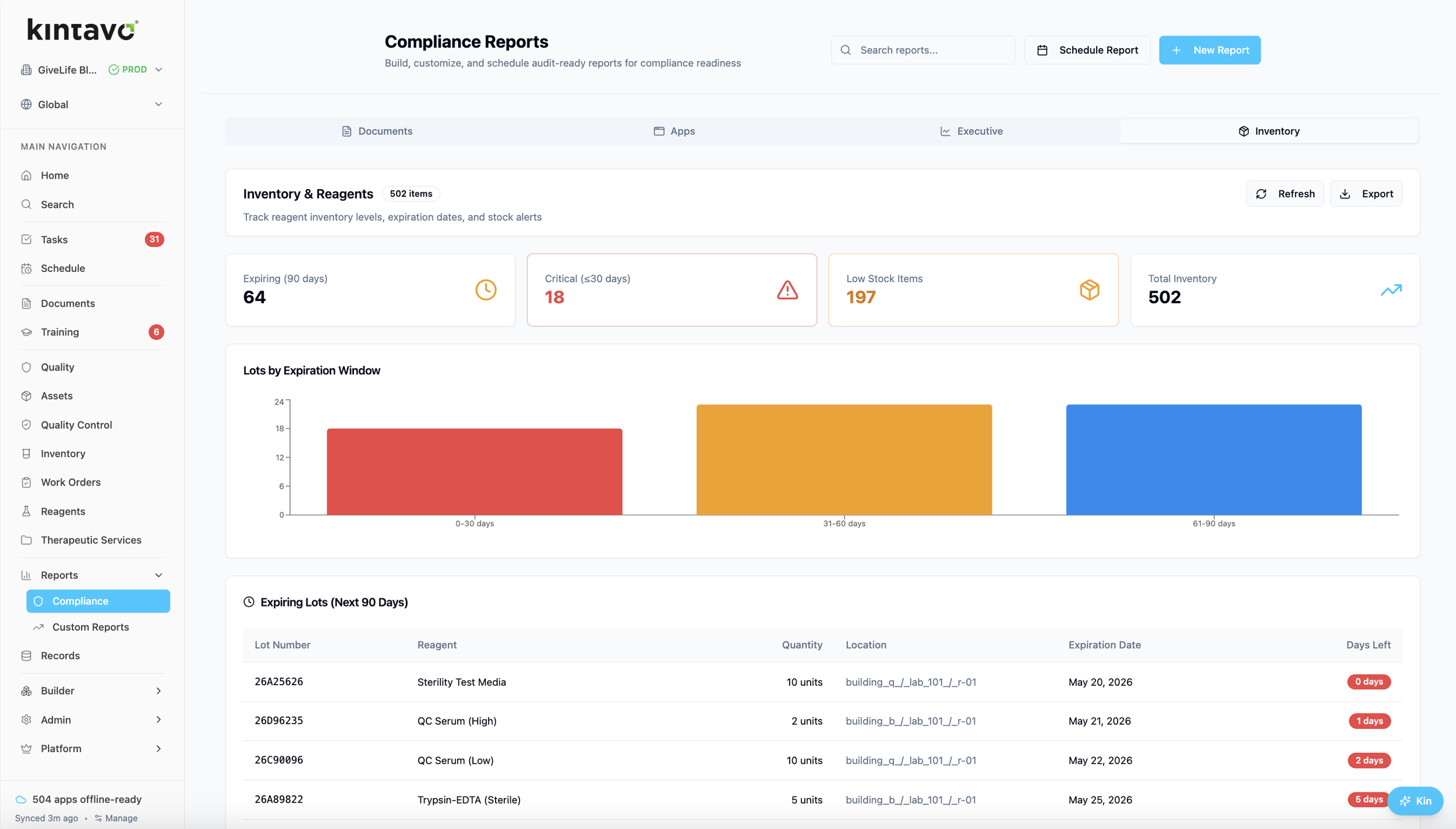
Apheresis machines, freezers, controlled-rate freezers, LN2 dewars — qualification and continuous monitoring.
Learn moreCalibration Tracking
Calibration of every measurement device in the cleanroom chain.
Learn moreAI Smart Assist™
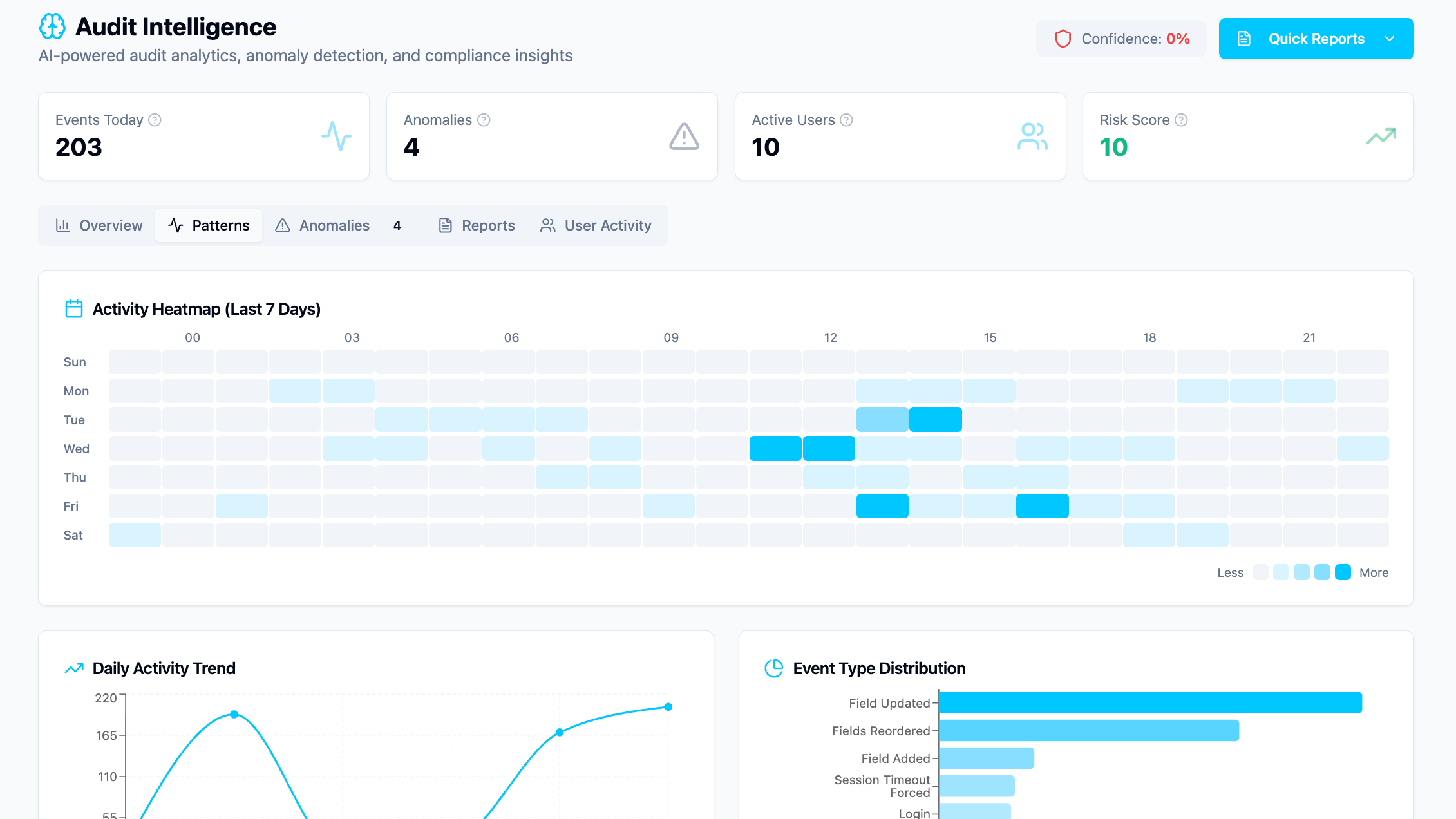
Pattern detection across patient cohorts that no manual review has time to surface.
Learn more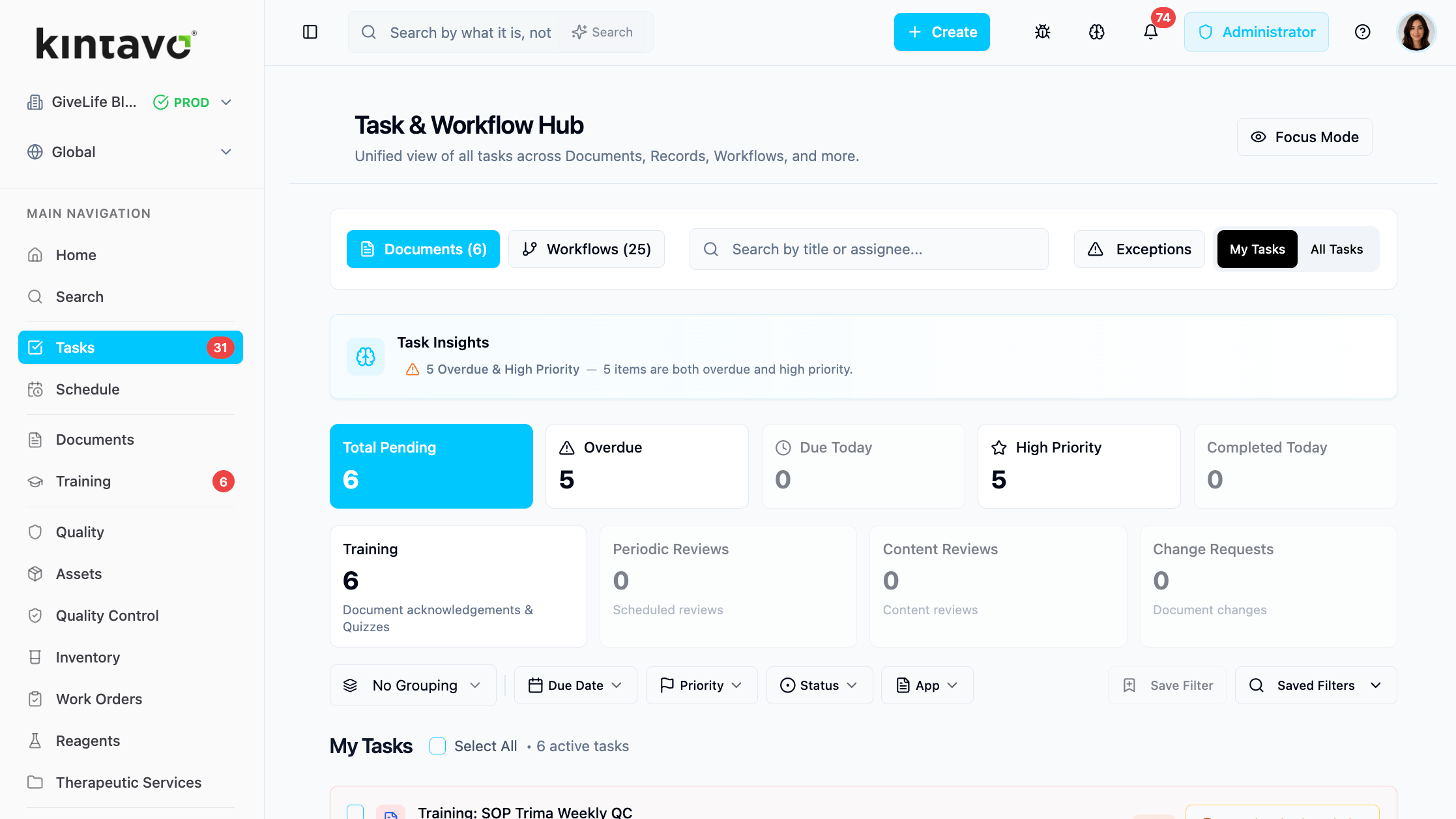
Compliance coverage for cell and gene therapy programs.
A regulatory framework that is still being written — and a platform built knowing it.
FDA Human Cells, Tissues, and Cellular and Tissue-Based Products (HCT/Ps).
FDA cGMP for finished pharmaceuticals — for licensed CGT products.
Foundation for the Accreditation of Cellular Therapy standards.
Joint Accreditation Committee ISCT-Europe & EBMT standards.
FDA electronic records and signatures.
Sterile product manufacture requirements.
Security and availability controls for patient and therapy data.
Chain of identity, 14-day window.
Apheresis to infusion — the patient is the lot.
When your CGT program runs on Kintavo.
Chain-of-identity survives the 14-day window. Per-patient batch records stay current. Deviations cluster before they become clinical holds.
Chain-of-identity survives the 14-day apheresis-to-infusion window — without a single manual reconciliation.
Per-patient batch records carry signatures the FDA accepts.
Deviations cluster across cohorts in time to act, not in retrospect.
The science moves faster than the paperwork — for once.
Your manufacturing and clinical teams work from one chain of identity — not from courier paperwork and infusion logs. Kintavo is the system the therapy can move at the speed of.
Book your demoFAQ Questions & Answers
Q: Is Kintavo built for cell and gene therapy quality programs? Kintavo is configured for the specific quality management requirements of cell and gene therapy programs — autologous CAR-T and other patient-specific products, allogeneic manufacturing, and hybrid workflows. Chain-of-identity tracking maintains lot integrity from apheresis through infusion. Per-patient batch records carry 21 CFR Part 11 compliant electronic signatures. Deviation Management captures process nonconformances with cohort-aware clustering so patterns surface across patients before they become clinical hold triggers. Equipment Management tracks qualification and monitoring for apheresis machines, controlled-rate freezers, and liquid nitrogen storage. The platform is built for CGT manufacturing reality, not adapted from batch pharma software.
Q: How does chain-of-identity work in Kintavo for autologous CGT? Chain-of-identity in Kintavo is a tracked record that links the patient to their apheresis collection, the lot generated from that collection, every manufacturing step and QC result for that lot, cryopreservation records, chain-of-custody during logistics, and the infusion event — with 21 CFR Part 11 electronic signatures at each step. At every handoff point, COI verification is a required step in the workflow before the next stage begins. If a COI discrepancy is detected at any point, the deviation workflow initiates immediately and the lot is held pending investigation. The complete COI record for any patient lot is retrievable in seconds for clinical or regulatory review.
Q: How does Kintavo support FACT accreditation? Kintavo's quality system infrastructure covers the core FACT standards requirements — controlled procedures for collection, processing, and administration; personnel training and competency; equipment qualification; deviation and CAPA management; and quality management oversight. Audit Intelligence™ can be configured against FACT Standards requirements, continuously monitoring your quality records for gaps that would generate a FACT finding. Pre-inspection reports identify open items mapped to specific FACT Standards before an assessor arrives. The full quality system evidence package for FACT accreditation and re-accreditation is maintained in Kintavo and retrievable in hours rather than weeks of manual compilation.
Q: How does deviation management work for CGT manufacturing? CGT deviations — apheresis collection deviations, manufacturing process excursions, QC release failures, cold chain breaks, and infusion-related events — are captured in structured workflows with required fields by event type and severity. Each deviation links to the patient lot affected, the equipment involved, the procedure in effect, and the personnel who performed the step. AI Smart Assist™ performs cohort-level analysis across deviations, surfacing patterns that repeat across multiple patient lots — the same collection deviation category, the same equipment generating yield failures, the same processing step generating OOS results — before any single deviation would suggest a systemic problem. Cross-lot pattern detection is the difference between catching a process drift early and triggering a clinical hold after the signal has been visible in the data for weeks.
Q: How does Kintavo handle allogeneic CGT manufacturing differently from autologous? Allogeneic workflows in Kintavo operate as conventional batch manufacturing records with donor lot tracking, multi-dose yield management, and release testing documentation — using the same Document Control, Deviation Management, CAPA, and Equipment Management infrastructure as the autologous chain-of-identity workflow. The difference is the lot structure: allogeneic lots trace to a donor rather than a recipient patient, and a single manufacturing lot may generate hundreds of doses. Quality events for allogeneic lots route through batch-level investigation workflows with impact assessment across all doses from the affected lot. Organizations running both autologous and allogeneic programs manage both under the same Kintavo tenant.
Q: How does equipment qualification work for CGT-specific equipment? CGT manufacturing equipment — apheresis machines, CliniMACS and similar cell selection systems, bioreactors, controlled-rate freezers, liquid nitrogen storage dewars, and cryogenic transport containers — can all be managed in Kintavo's Equipment Management module with IQ/OQ/PQ qualification records, calibration schedules, preventive maintenance workflows, and continuous temperature and environment monitoring linkage. When a freezer temperature excursion occurs, Kintavo can initiate a deviation automatically and flag every patient lot stored in the affected unit for impact assessment. The complete equipment history for any asset is retrievable in seconds for a FACT audit or FDA inspection.
Q: How does training management work for CGT manufacturing staff? CGT manufacturing procedures evolve rapidly — especially in early-phase programs where processes are still being optimized. In Kintavo, when a procedure is revised and approved, training automatically assigns to every staff member whose role requires competency on that procedure. Training tasks require a 21 CFR Part 11 electronic signature acknowledgment. For procedures requiring demonstrated competency — aseptic technique, cell counting, cryopreservation, COI verification — supervisor sign-off captures the competency assessment in the same record. When a procedure is written for the first time, the training assignment routes on approval. When FACT auditors ask for training records for the manufacturing staff who processed a specific patient lot, the complete training history is retrievable immediately.
Q: How does Kintavo support IND-enabling and BLA quality system requirements? For investigational CGT programs operating under IND, Kintavo provides the quality system infrastructure the FDA expects to see during manufacturing inspections — controlled procedures, deviation investigation, CAPA, training records, equipment qualification, and 21 CFR Part 11 electronic records. As programs advance toward BLA submission, the same Kintavo system that governed clinical manufacturing provides the historical quality record for the BLA filing. The transition from IND to licensed manufacture does not require a system change — Kintavo scales the quality workflows from investigational to commercial manufacturing requirements through configuration, not re-implementation.
Q: Can Kintavo support multi-site CGT manufacturing networks? Yes. CGT programs operating across multiple manufacturing sites — apheresis collection centers, central manufacturing facilities, and satellite infusion centers — can be managed under one Kintavo tenant with site-specific permissions, workflow configurations, and reporting. COI tracking follows the patient lot across site boundaries. Quality events at any site route through the appropriate investigation and notification workflows. Quality leadership sees consolidated metrics across all sites. Cross-site trending — identifying the same collection deviation pattern at multiple apheresis centers, for example — is visible from the central dashboard without requiring separate reports from each location.
Q: Is Kintavo 21 CFR Part 11 compliant for CGT records? Yes. Every record in Kintavo — COI verification steps, batch manufacturing records, QC release decisions, deviation records, CAPA closures, training completions — is captured with a time-stamped, user-attributed electronic signature that meets 21 CFR Part 11 requirements. The audit trail is immutable and exportable. For CGT programs under FDA oversight operating under 21 CFR 1271, 21 CFR 210/211, or both, Kintavo's electronic record infrastructure satisfies the predicate rule requirements and the electronic signature requirements of Part 11 from the same platform.
Q: What does implementation look like for a CGT program? Your implementation lead works with your manufacturing and quality teams to configure chain-of-identity workflows, per-patient batch record structure, deviation categories, equipment records, training curricula, COI verification steps, cryopreservation and logistics workflows, and regulatory framework mappings — typically within the first two to three weeks of onboarding. Kintavo provides IQ/OQ documentation to support GxP computerized system validation. Existing SOPs, equipment records, and open quality records can be migrated from spreadsheets or prior systems. Most CGT programs are processing live quality events in Kintavo within 30 days of kickoff.
Cell & gene therapy operates in a regulatory framework still being written.
Per-patient lots. Autologous workflows where the patient is the lot. Allogeneic processes where one donor becomes a hundred treatments. Chain-of-identity that must survive courier handoffs, cryopreservation, and clinical infusion — every single time.
The QMS solutions built for batch pharma cannot model this. Kintavo was built knowing it.