Deviation Management
Every quality event captured, investigated, and resolved.
Capture events in seconds, triage by risk, and drive investigations to closure with AI-suggested root-cause links to related records.
A Deviation Tracked in a Spreadsheet Is an Investigation Without Evidence.
Quality events start as emails, hallway conversations, and rows in a tracking sheet. Severity is assigned inconsistently. Investigations stall unnoticed. And the record an inspector eventually sees was assembled after the fact — which is exactly what it looks like.
The consequence compounds: without structured deviation data there is no trending, and without trending, the same failure recurs until it becomes a 483 observation instead of a data point.
What 21 CFR 211.192, ISO 13485, and GMP Require From Deviation Records
Part 211.192 requires any unexplained discrepancy to be thoroughly investigated, with the investigation and conclusions documented. ISO 13485 clause 8.3 requires nonconforming product to be identified, controlled, and dispositioned under authority. Every GMP framework expects severity classification, timeline discipline, and escalation to CAPA when warranted.
A tracking spreadsheet meets none of these. Kintavo meets all of them by construction — structured capture, enforced timelines, and a signed investigation trail are how the module works, not habits your team must keep.
The old way, retired.
This is the actual screen.
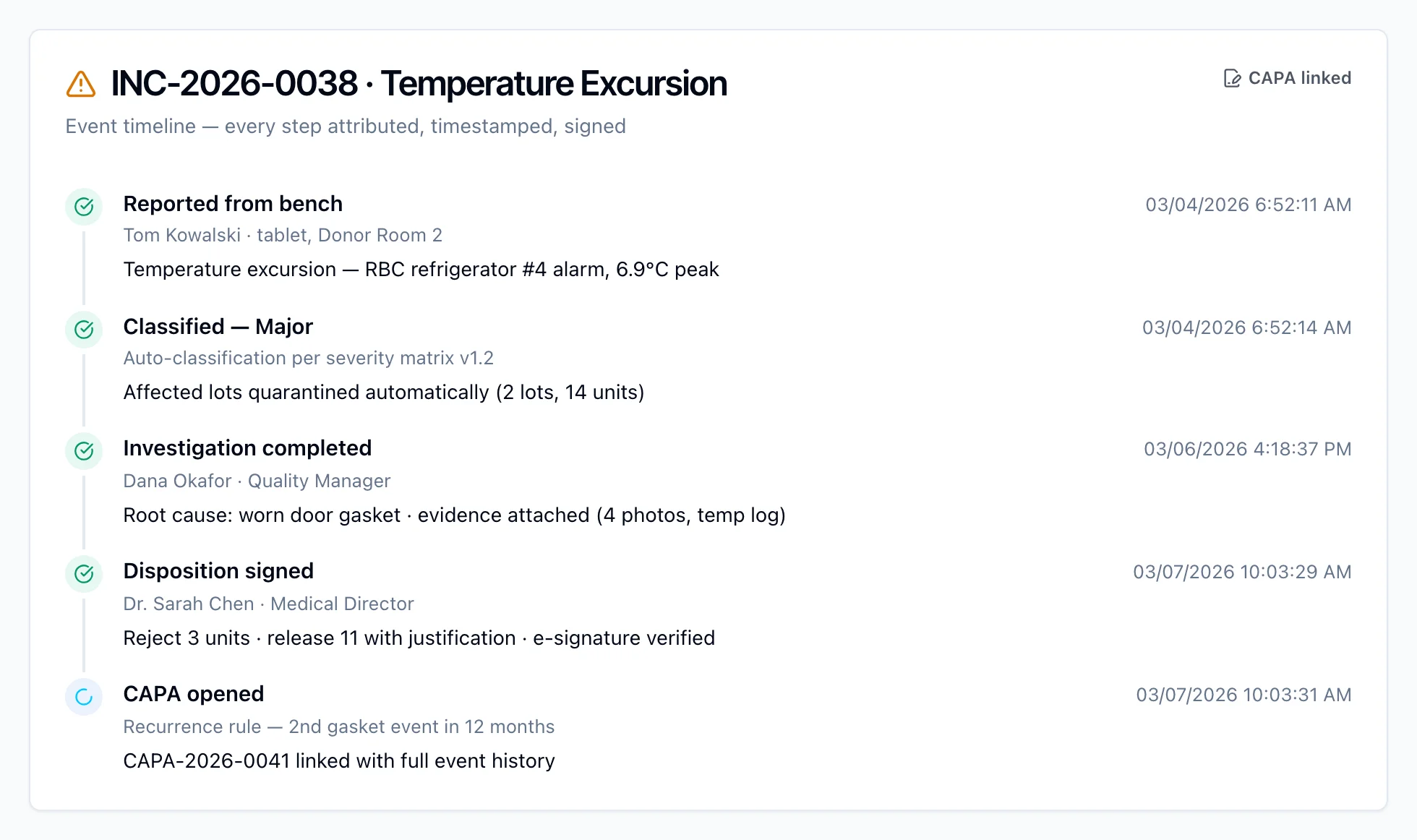
From First Report to Signed Closure. One Record.
A tech notices a temperature excursion in a reagent refrigerator and reports it from a tablet in under a minute. The event auto-classifies as major, quarantines the affected lots, and opens an investigation assigned to the supervisor with a five-day due date. The disposition — reject two lots, release one with justification — is signed by the quality manager. When the same unit deviates again a month later, the trend flags it and a CAPA opens with both events attached.
Part of one connected system.
Deviation Management shares the same data model, AI engine, and audit trail as the other eighteen modules — so its records see, and are seen by, everything else in your quality system.
Deviation Management FAQ
Can bench staff report deviations directly?
Yes — from a browser or tablet, in about a minute. Structured intake captures the event type, immediate actions, and affected items at the moment of discovery, not at the end of the shift.
How does Kintavo decide what escalates to CAPA?
Your classification rules do. Severity and recurrence criteria are configured to your SOPs; when a threshold is met, a linked CAPA opens carrying the complete deviation history.
Can deviations quarantine inventory automatically?
Yes. Affected lots are quarantined from the event record itself, blocking them from every workflow that could consume them until disposition.
Does Kintavo support deviation trending?
Yes — live trending by type, area, product, and root cause, so recurring events surface as a signal instead of an inspection finding.