Equipment Management
Full lifecycle control from qualification to retirement.
One record per asset, from IQ/OQ/PQ through maintenance history to retirement — with every calibration and repair on the timeline.
An Instrument You Can't Prove Was Qualified Casts Doubt on Every Result It Produced.
Equipment records scatter by nature: qualification binders in a cabinet, calibration certificates in email, service visits on paper, status tracked in a spreadsheet. Each instrument has a history — but no one place where it is a history.
When an out-of-calibration event surfaces, the real question is retrospective: which results did this instrument touch, since when, and who was told? Assembled by hand, that answer takes weeks. Meanwhile the results stand on an instrument you cannot vouch for.
What Part 820.70, ISO 13485, and CAP Require From Equipment Records
Part 820.70(g) requires equipment to be appropriately designed, maintained per schedule, and its maintenance documented. ISO 13485 clause 6.3 requires maintenance requirements and records for equipment affecting product quality. CAP and CLIA require function verification before patient testing resumes after repair — with records to show it.
A binder per instrument meets the letter and fails the retrieval. Kintavo keeps the whole lifecycle on the asset — qualification, schedules, service, and linked events — so the record is the same thing as the answer.
The old way, retired.
This is the actual screen.
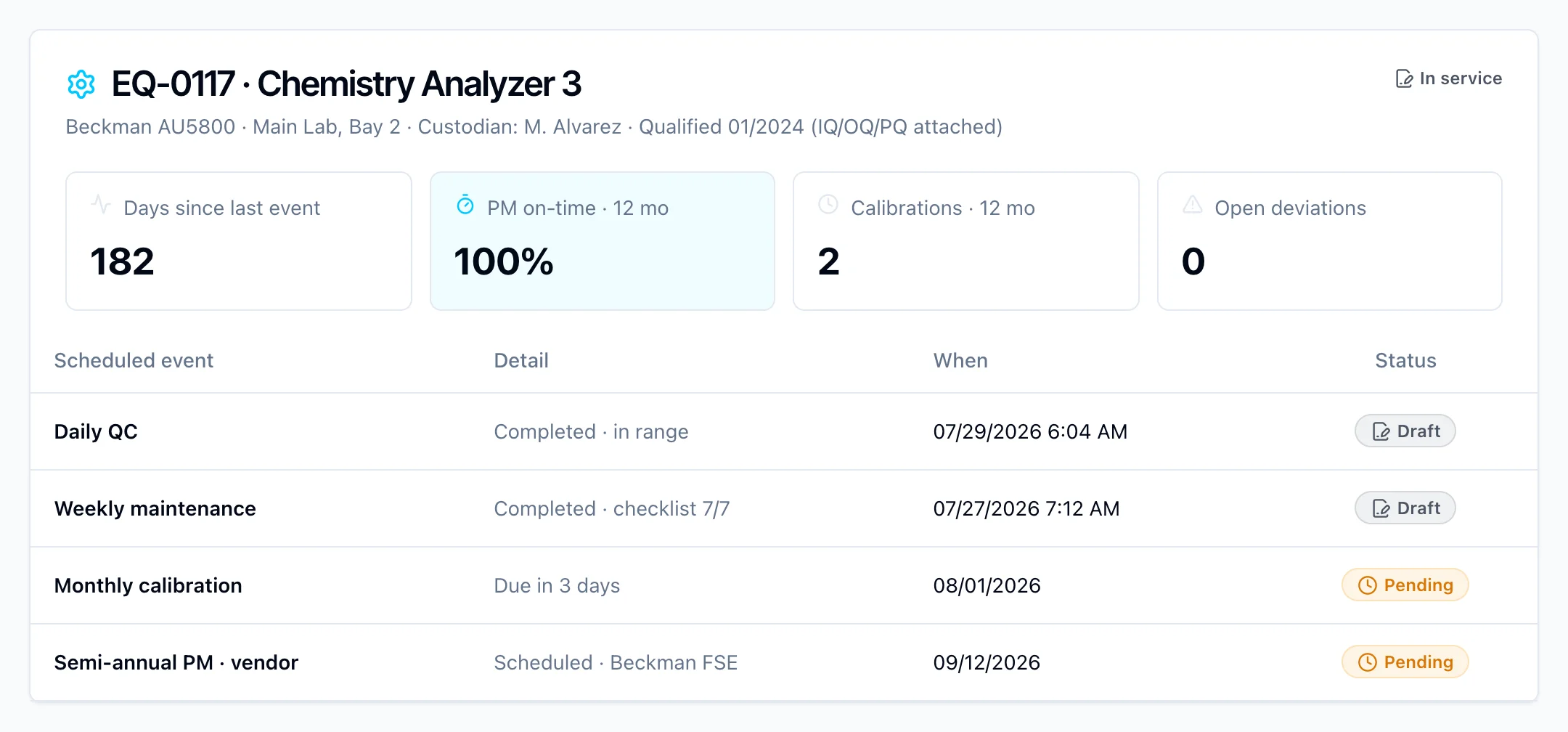
The Asset Is the Record.
A chemistry analyzer fails its daily QC. The tech flags it from the bench; the instrument quarantines instantly — no new results can be recorded against it. The service visit is logged with findings and parts; return to service requires function verification signed by the supervisor. The event record carries the context an investigator needs — the instrument, its QC history, and the review task routed by your configured workflow.
Part of one connected system.
Equipment Management shares the same data model, AI engine, and audit trail as the other eighteen modules — so its records see, and are seen by, everything else in your quality system.
Equipment Management FAQ
Can Kintavo hold our IQ/OQ/PQ documentation?
Yes — qualification protocols and executed evidence attach to the asset record, and repair or relocation can trigger requalification tasks automatically.
What happens when an instrument fails QC or breaks down?
It quarantines: workflows that would record results against it are blocked until function verification is signed. The failure, the service, and the verification all land on the asset timeline.
How do we assess impact when an instrument fails?
Yes. Because results, QC runs, and events link to the asset, "everything this instrument touched since the last passing check" is a query, not a project.
Does Kintavo replace our CMMS?
For regulated equipment, it can — and it adds what a CMMS lacks: signatures, quarantine enforcement, and audit-ready linkage to quality records. For general facilities assets, it integrates via API.