Quality Management Software for Cell and Gene Ther | Kintavo
SPECIALIZED THERAPIES & TISSUE PROGRAMS

Cell & Gene Therapy

Patient-specific lots, chain-of-identity, and the regulatory rigor that comes with autologous and allogeneic therapies.

Chain-of-identity Per-patient lots FACT / JACIE
Book a demo for cell & gene programs ← All industries
THE PROBLEM

When the Batch Size Is One, Every Deviation Is a Patient Conversation.

Autologous manufacturing inverts every quality assumption: no retains, no re-runs, no statistical release. Chain of identity must hold from apheresis chair through manufacturing to infusion — across organizations — and a deviation cannot be dispositioned against the next batch, because there is no next batch. There is a patient, waiting.

Programs scale from five patients to five hundred faster than paper travelers and spreadsheet trackers can survive. The quality system either scales with the pipeline or becomes the pipeline’s constraint.

REGULATORY REQUIREMENTS

What FACT, 21 CFR 1271, and GMP Require From Cell Therapy Quality

FACT and JACIE standards require a quality program spanning collection, processing, and administration — with chain of identity and custody documented at every transfer. 21 CFR 1271 adds GTP: donor eligibility, processing controls, and tracking from donor to recipient. Commercial products layer full GMP on top, with Part 11 governing the records.

Kintavo holds the thread: identity checkpoints as enforced workflow steps, deviations with patient-impact assessment, and traceability that follows the product across sites and systems.

WHAT AUDITORS LOOK FOR
Chain-of-identity transfers documented after the fact, or not at all.
Deviations dispositioned without documented patient-impact assessment.
Donor eligibility records incomplete at the time of processing.
Cross-site handoffs where custody documentation changes format and loses fidelity.
WHAT KINTAVO REPLACES
Paper travelers per lot → Electronic batch records with identity checkpoints
Identity verified by diligence → Two-person verification enforced at every transfer
Deviation review by meeting → Events with patient-impact assessment and escalation
Site-to-site handoff by fax → Custody chain in one system, both sides signed
Scaling by hiring coordinators → Scaling by workflow
CORE CAPABILITIES

Identity Held. Custody Signed. Patient Protected.

Chain of Identity Checkpoints
Two-person verification steps enforced at collection, receipt, processing, and release — identity cannot be assumed past them.
Per-Lot Batch Records
Patient-specific electronic records with every step signed — the traveler, without the paper.
Deviation with Patient Impact
Every event carries a patient-impact assessment and medical review before disposition.
Cross-Site Custody
Transfers between apheresis, courier, and manufacturing signed on both ends, one record.
Training & Competency
Technique-level competency — processing, cryopreservation, release testing — gating who can sign.
360° Compliance Map™
Donor to product to patient, navigable both directions, every hop signed.
WHAT IT LOOKS LIKE IN PRACTICE

An apheresis product arrives at manufacturing at 6:40 a.m. Receipt is a two-person identity verification against the collection record — enforced, not procedural. At step four, a viability result lands out of range: the deviation opens with patient-impact assessment routed to the medical monitor before any disposition. The product releases eleven days later with every step, signature, and decision on one record — ready for the FACT inspection and, more importantly, for the patient.

EVIDENCE, NOT CLAIMS

The Identity Chain, Signed at Every Link.

Collection, receipt, each processing step, release, infusion — every custody transfer carries two signatures and a timestamp. When FACT inspectors trace a product, the chain is a record, not a reconstruction.
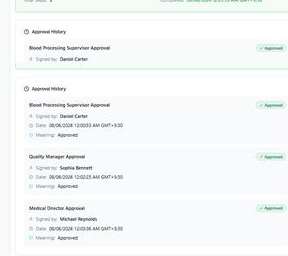
Two-signature approval chain with signer, date, and meaning on each signature
SHOWN WITH SAMPLE DATA. YOUR NUMBERS APPEAR THE DAY YOU CONNECT YOUR SYSTEM.

Configured for your rules from day one.

IDENTITY
Chain of identity, unbroken
Per-patient lots tracked from apheresis to infusion with every custody handoff signed and logged.
FACT
FACT / JACIE readiness
Accreditation evidence assembled continuously — including the CIBMTR reporting nobody enjoys.
SPEED
Vein-to-vein timelines
Quality events resolved at the pace of patient-specific manufacturing — hours matter.
“
"Employees praised Kintavo's intuitive design, flexibility, simplicity, and the support received from the team."
MD Anderson Cancer Center Houston, TX
MOST USED BY CELL & GENE PROGRAMS TEAMS
Deviation Management → Equipment Management → Training Management → CAPA Management → 360° Compliance Map™ →
QUESTIONS & ANSWERS

Cell & Gene Therapy FAQ

Can Kintavo enforce chain of identity?
Yes — identity checkpoints are workflow steps requiring two-person verification; the process cannot proceed past an unverified transfer. Enforcement, not reminder.
How are deviations handled for patient-specific lots?
Every event carries a patient-impact assessment routed to medical review before disposition — because use-as-is means something different when the lot is the patient.
Does Kintavo support FACT accreditation?
The quality program FACT inspects — documents, training, deviations, traceability — runs as daily workflow, with evidence retrievable live during inspection.
Can the system span collection, manufacturing, and clinical sites?
Yes — custody transfers are signed on both ends in one system, with role-based access keeping each organization inside its own view.

See Kintavo configured for cell & gene programs.

Bring your real pain points. We'll show you exactly how it solves them — in your regulatory language.

Book a Personalized Demo
RELATED Who runs on Kintavo → Hoxworth case study → Compare platforms → Pricing →