
Inventory Management Software for Regulated Labs | Kintavo
Platform · Operations · Inventory & Supplies
Module · Operations · 21 CFR Part 11

Inventory Management Software for Regulated Labs

Anyone can count your inventory. Only a quality system can sign for it. Kintavo runs reagents, supplies, and consumables on an append-only ledger — every receive, consume, and correction electronically signed and inspection-ready.
Book Your Personalized Demo Get a Free Gap Assessment
21 CFR Part 11 CLIA · CAP AABB ISO 15189
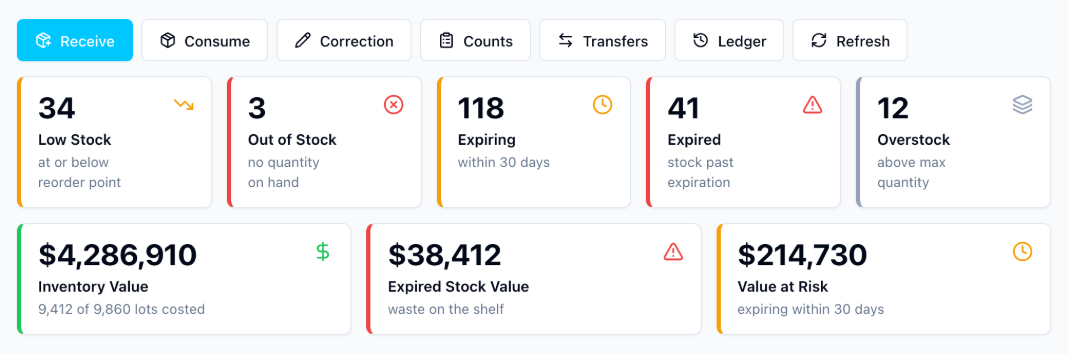
Kintavo inventory metric band: 34 low stock, 118 expiring within 30 days, $4,286,910 inventory value, $214,730 value at risk
Shown with sample data sized to a large academic laboratory. Your numbers appear the day you connect your inventory.
The Problem

An Expired Reagent on the Shelf Isn't a Stocking Error — It's a Citation.

Most regulated labs run inventory from a spreadsheet, a whiteboard, or the inventory module of a system that was never built for compliance. Stock counts live in editable cells no inspector will accept as evidence. Lot status is a free-text field anyone can change. And when an auditor asks which results used a specific reagent lot, the answer is assembled by hand — from four systems, over two days.

The cost isn't only the finding. Labs without expiry visibility routinely write off five figures of expired stock a year — and can't price the waste, let alone prevent it.

Regulatory Requirements

What 21 CFR Part 11, CLIA, and AABB Require From Inventory Records

Inventory records in a regulated lab are quality records. Part 11 requires electronic records to be attributable, signed, and protected from alteration. CLIA and CAP checklists require reagent lot documentation, expiry control, and qualification before use. AABB standards extend the same discipline to blood bank reagents — with documented lot status and release control.

A spreadsheet meets none of these. Kintavo meets all of them by construction — signatures, quarantine gating, and an append-only ledger are how the module works, not settings you configure.

What Auditors Look For
Expired or unqualified reagents accessible at the bench — the most common inventory-related deficiency in CAP inspections.
Stock adjustments without a documented reason, operator identity, or signature — editable records read as no records.
No traceability from a QC result back to the reagent lot that produced it — one question, two days of manual assembly.
New lots in use before qualification — lot status fields that nothing actually enforces.
What Kintavo Replaces
Inventory spreadsheetsLive lot & expiry dashboards with waste measured in dollars
Editable stock recordsAppend-only ledger: who, what, before/after, why — forever
Uncontrolled lot status fieldsQuarantine-to-release qualification under e-signature
Manual counts on paperCycle counts that post signed variances
A separate 'inventory app'One platform — same signatures, same audit trail as your QMS
Core Capabilities

The Whole Loop, Signed and Permanent.

Barcode Receive & Consume
Scan in, scan out — with first-expiring-first-out defaults steering every consume, from a phone or tablet at the bench. No companion app with lighter rules.
Lot Qualification & Quarantine
New lots arrive quarantined and are blocked from use everywhere until QC signs the release. "Which results used lot X?" is one search.
Append-Only Transaction Ledger
Every movement recorded with operator identity, before-and-after quantities, and stated reason — on a ledger the database itself refuses to alter.
Waste Priced in Dollars
Expired stock value and value-at-risk on the dashboard — with a daily attention digest surfacing low stock, expiring, and expired to admins and QMs.
Signed Cycle Counts & Transfers
Counts post signed variances; transfers carry a signed chain of custody between buildings, freezers, and sites.
Role-Based Cost Visibility
Valuation is a role-based view — bench staff work from stock, lot, and expiry while cost stays with quality management.
Evidence, Not Claims

Every Movement Is a Ledger Row an Inspector Can Read.

Who acted, what changed, before-and-after quantities, and the stated reason — captured at the moment of the transaction, signed with password re-authentication, and exportable while the inspector is still in the chair.
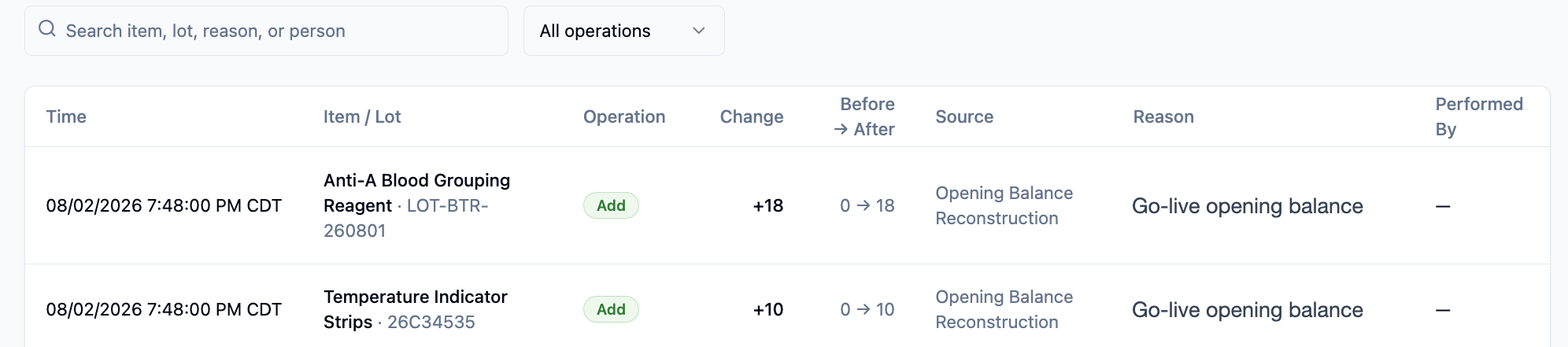
Kintavo transaction ledger rows showing timestamped inventory operations with before-and-after quantities, source, and reason
Shown with sample data. Your numbers appear the day you connect your system.
What It Looks Like in Practice

A new reagent shipment arrives. The tech scans it in on a tablet — it lands quarantined, invisible to every workflow that could consume it. QC runs the lot-to-lot comparison and the supervisor signs the release; only then does it reach the bench. Weeks later an inspector asks about a March stock adjustment. Two clicks: the ledger row — operator identity, timestamp, before-and-after quantities, stated reason, and the signature captured with password re-authentication. It cannot be edited or deleted, and it exports while the inspector is still in the chair.

Works With
QC Analysis →
Every QC run records the reagent lot it consumed.
Document Control →
Package inserts and SOPs under version control, linked to the item.
Training Management →
Only trained, current operators can receive, consume, or count.
Built For
Clinical Laboratories →
CLIA, CAP, and ISO 15189 reagent management.
Blood Banks & Transfusion →
AABB reagent qualification and traceability.
Pharma & Biotech →
GMP material control under 21 CFR 211.
Questions & Answers

Inventory & Supplies FAQ

Does Kintavo replace our LIMS inventory module?
It can, or it can sit alongside it. Kintavo adds the quality layer — signed transactions, lot quarantine, append-only ledger — and integrates with existing LIMS, ERP, and BECS platforms via API.
Is inventory data 21 CFR Part 11 compliant?
Yes. Every receive, consume, correction, and transfer is electronically signed with operator re-authentication and recorded on an append-only audit trail the database itself refuses to alter.
How does lot quarantine work?
New reagent lots arrive quarantined and are blocked from every workflow that could consume them until QC signs the release. Every QC run records the lot it consumed — traceability is one search, not a two-day assembly.
Can we migrate from spreadsheets?
Yes. Your existing inventory spreadsheet is adopted without re-keying — items, lots, quantities, and locations load as an opening balance under signature, and the ledger starts from there.
Getting Started

Bring the spreadsheet you use today. Leave with it running in Kintavo.

01
Book Your Demo
Bring the spreadsheet and one QC log you use today; leave with both running in Kintavo.
02
Gap Assessment
We map your highest compliance-exposure areas across inventory and QC.
03
Begin Implementation
Guided migration, validation docs, role-based training, and go-live support.
Book a Personalized Demo Get the Free Assessment
RELATED All 19 modules → Compare platforms → Pricing → Who runs on Kintavo →