Audit Management
Inspection-ready before the auditor walks in.
Internal, supplier, and external audits in one calendar — findings flow straight into CAPAs with owners and due dates.
Audit Prep as a Fire Drill Means the System Fails Between Audits.
The internal audit schedule lives in a spreadsheet; the findings live in reports nobody reopens; the corrective actions live in email. Six weeks before an inspection, the organization drops everything to reconcile all three — and the reconciliation itself becomes the evidence that quality is an event, not a system.
The self-inflicted wound: internal audit findings that were never tracked to closure. Nothing hands an inspector a finding faster than your own audit report describing a problem nobody fixed.
What Part 820.22, ISO 19011, and ISO 13485 Require From Audit Programs
Part 820.22 requires audits by trained individuals independent of the area audited, with documented results and re-audits of deficient matters. ISO 13485 clause 8.2.4 requires planned internal audits at defined intervals with correction and verification. ISO 19011 sets the discipline: programs based on risk, documented criteria, competent auditors, and follow-up.
A spreadsheet schedule and a findings folder meet the letter until the first missed follow-up. Kintavo runs the program as a system — scheduled by risk, findings owned and dated, closure verified — so readiness is the steady state.
The old way, retired.
This is the actual screen.
The Program Runs Itself. The Findings Close Themselves Out.
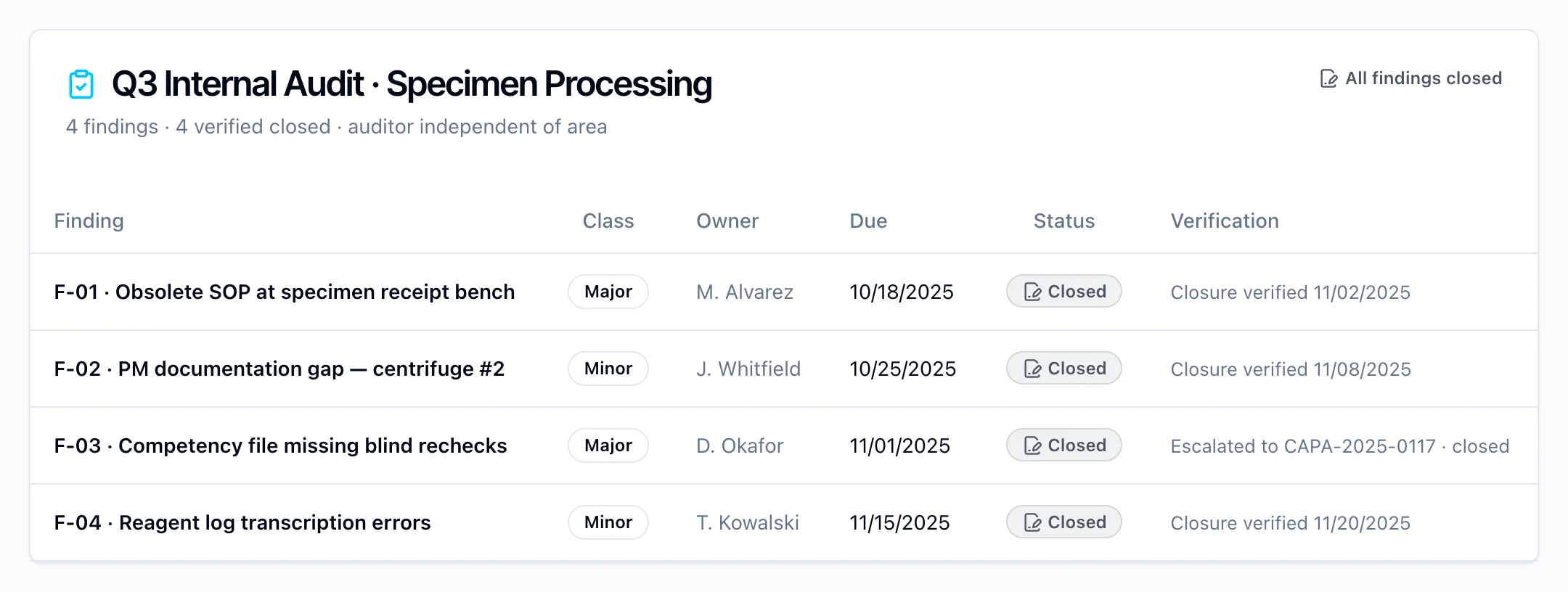
The Q3 internal audit of specimen processing logs four findings. Each gets an owner and a due date at the closing meeting — one meets the CAPA threshold and escalates with its evidence attached. When the CAP inspector arrives in November, the team opens inspection mode: every document request is logged and answered in under a minute, and the Q3 findings show verified closure. The inspector notes the follow-through in the summation.
Part of one connected system.
Audit Management shares the same data model, AI engine, and audit trail as the other eighteen modules — so its records see, and are seen by, everything else in your quality system.
Audit Management FAQ
Can Kintavo manage external inspections, not just internal audits?
Yes. Inspection mode logs every request, tracks what evidence was shown, and assigns follow-ups in the room — so the inspection record is complete the day the inspector leaves.
How do audit findings become CAPAs?
Classification rules you configure. Findings meeting the threshold open a linked CAPA carrying the finding, its evidence, and the audit context — nothing re-keyed.
Does Kintavo enforce auditor independence?
Yes — auditor assignments check area independence per Part 820.22, and exceptions require documented justification.
Can we use our existing audit checklists?
Yes. Your checklists load as reusable templates, refined cycle over cycle, with per-item evidence and scoring.