CLIA and CAP Compliance Software for Clinical Labo | Kintavo
← ALL FRAMEWORKS
COMPLIANCE COVERAGE

{{ c.h1 }}

{{ c.sub }}

{{ chip }}
THE PROBLEM

The CAP Checklist Has Thousands of Line Items. Your Evidence Lives in Forty Places.

CAP inspection prep is an archaeology project: QC records at the analyzers, competency in a spreadsheet, reagent logs in binders, maintenance on clipboards, procedure manual signatures in a folder nobody opens between cycles. The checklist asks for evidence at line-item level; the lab produces it by reconciliation sprint, every two years, at the cost of weeks.

CLIA raises the stakes: condition-level deficiencies threaten the certificate itself, and the director’s personal responsibility is written into 493. The gap between daily practice and documented practice is the whole game.

WHAT THE STANDARD REQUIRES

What CLIA 493 and CAP Checklists Require From the Laboratory

CLIA requires control procedures detecting immediate error (493.1256), competency assessment on six defined elements — semiannual in year one, annual after — (493.1451), personnel qualifications, proficiency testing, and a director answerable for all of it. CAP checklists convert those into line items inspectors sample: reagent lot verification, maintenance at frequency, QC corrective action before result release, document review on schedule.

Kintavo generates the evidence as the work happens: the QC criterion fires at entry, the competency cycle schedules itself, the reagent lot cannot reach the bench unqualified. Inspection prep becomes a walkthrough of records that already exist.

WHAT AUDITORS LOOK FOR
QC failures with results released before corrective action — the citation with patient impact.
Competency files missing elements or off-cycle — sampled by name, found in seconds or not at all.
Expired reagents accessible at the bench.
Procedure manuals unsigned by the current director, or signed en masse last week.
WHAT KINTAVO REPLACES
Evidence in forty places → Evidence generated by the daily workflow
The biennial reconciliation sprint → Inspection-ready as the steady state
QC review in weekly batches → Rules at entry, exceptions escalated same-day
A competency spreadsheet → Six elements, on cycle, per person, automatic
Director oversight by meeting → Director dashboard with drill-down to the record
CORE CAPABILITIES

Checklist Evidence, Generated Daily.

QC at Entry (493.1256)
Acceptance criteria evaluated at entry, failures holding release, corrective records signed — exception-based review.
Six-Element Competency (493.1451)
Assessments scheduled per person on the CLIA cycle, with qualification gating on testing workflows.
Reagent & Lot Control
Quarantine-to-release qualification, expiry enforcement, and documented lot status and release control.
Maintenance & Function Checks
Instrument tasks at frequency, signed at the bench, escalated on miss.
Procedure Manual Control
Director review on schedule, revision-triggered training, obsolete versions locked out.
Proficiency Testing Tracking
PT events, results, and corrective action for failures — with attestation records.
WHAT IT LOOKS LIKE IN PRACTICE

The CAP inspector works the chemistry checklist. Reagent lot verification: the quarantine-to-release record, with the parallel testing attached. Maintenance at frequency: the analyzer’s schedule, every task signed at the bench, one miss — escalated and documented the same day. Competency: two techs sampled by name, both files complete and on cycle. The inspector moves faster than the paper-based lab next door will ever allow, and leaves with zero findings on the section.

EVIDENCE, NOT CLAIMS

The Inspector Samples. The Record Is Already There.

Checklist-level questions have record-level answers: this lot’s qualification, this tech’s competency, this failure’s corrective action — each created at the moment of the work, retrievable in the seconds an inspection allows.
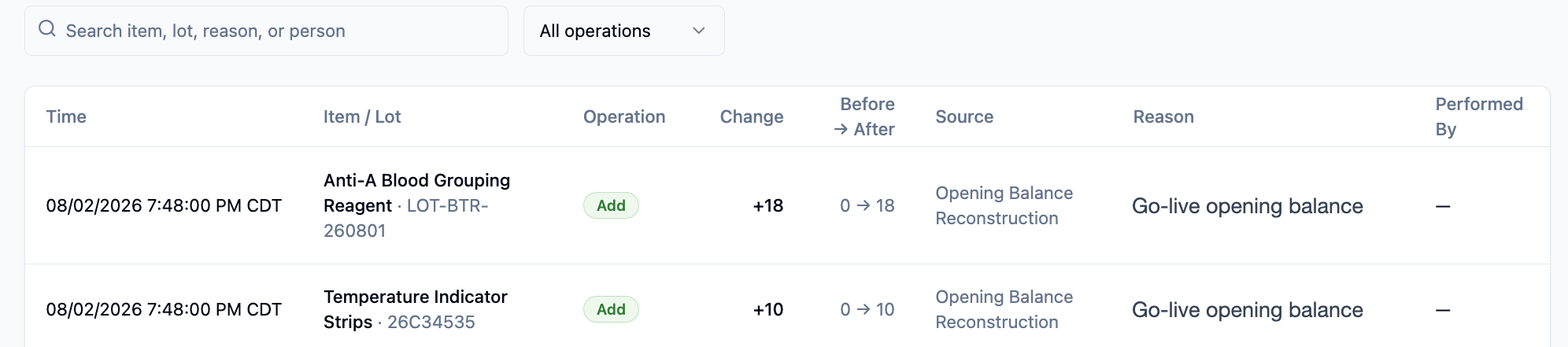
Kintavo append-only ledger rows showing timestamped reagent operations with operator and reason
SHOWN WITH SAMPLE DATA. YOUR NUMBERS APPEAR THE DAY YOU CONNECT YOUR SYSTEM.

Covered as architecture — not configured after the fact.

{{ p.tag }}
{{ p.title }}
{{ p.desc }}
MODULES THAT CARRY THE LOAD
{{ m.name }}→
WHO WORKS UNDER IT
{{ i.name }}→ Check your readiness in 3 minutes →
QUESTIONS & ANSWERS

CLIA & CAP FAQ

Does Kintavo organize evidence by CAP checklist?
Inspection evidence pulls from the workflows that created it — QC, competency, reagents, maintenance, documents — mapped to the checklist areas inspectors work through.
Does Kintavo support IQCP?
Yes — risk-based QC plans are configured per test system, with the risk assessment documented and the monitoring schedule enforced.
Can the lab director see everything they’re responsible for?
The director dashboard rolls up QC exceptions, competency status, overdue items, and pending reviews across sections — with drill-down to every record. 493’s personal responsibility, made visible.
How does proficiency testing fit?
PT events are scheduled and tracked with results, failures opening corrective action workflows, and attestation signatures captured — the full record CMS and CAP expect.

{{ c.cta }}

Book a Personalized Demo
RELATED For lab directors →